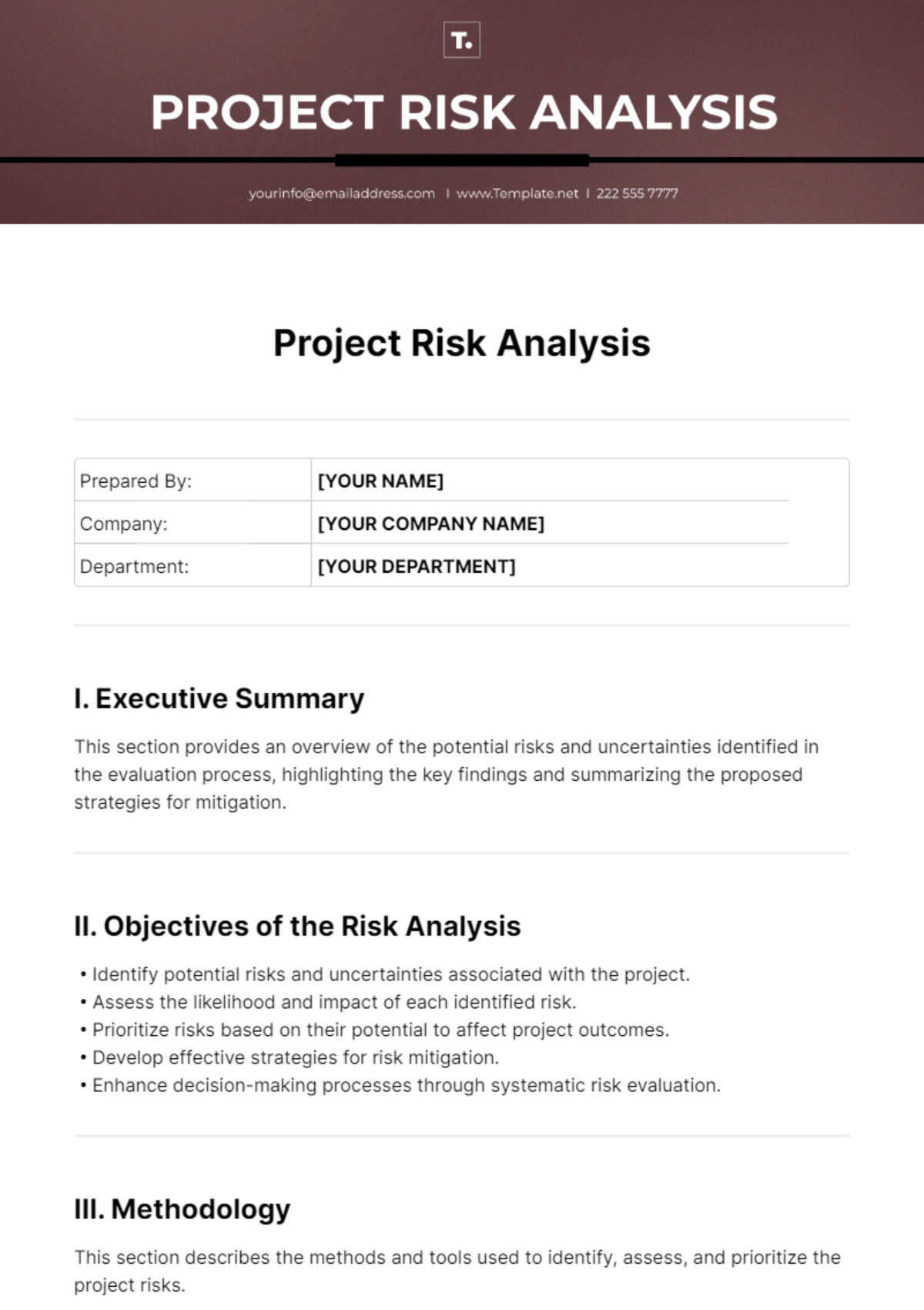
Free Project Risk Analysis

Prepared By: | [YOUR NAME] |
Company: | [YOUR COMPANY NAME] |
Department: | [YOUR DEPARTMENT] |
I. Executive Summary
This section provides an overview of the potential risks and uncertainties identified in the evaluation process, highlighting the key findings and summarizing the proposed strategies for mitigation.
II. Objectives of the Risk Analysis
Identify potential risks and uncertainties associated with the project.
Assess the likelihood and impact of each identified risk.
Prioritize risks based on their potential to affect project outcomes.
Develop effective strategies for risk mitigation.
Enhance decision-making processes through systematic risk evaluation.
III. Methodology
This section describes the methods and tools used to identify, assess, and prioritize the project risks.
A. Risk Identification
Discussion of techniques used to discover or recognize risks inherent in the project, which may include but are not limited to:
Brainstorming sessions
Expert interviews
Historical data analysis
SWOT analysis (Strengths, Weaknesses, Opportunities, Threats)
B. Risk Assessment
Explanation of how risks are evaluated considering their likelihood and potential impact on the project, utilizing tools such as:
Risk matrix
Probability and impact assessment
Scenario analysis
C. Risk Prioritization
Details on the process of ranking risks to focus management on the most critical ones, methods include:
Pareto principle application
Risk urgency assessment
Multi-criteria decision analysis (MCDA)
IV. Key Risks Identified
A table of identified risks along with their assessed likelihood, potential impact, and initial prioritization status.
Risk Description | Likelihood | Impact | Priority |
|---|---|---|---|
Supply Chain Disruptions | High | High | Critical |
Regulatory Changes | Medium | High | High |
Technological Failures | Medium | Medium | Medium |
V. Risk Mitigation Strategies
Discussion of strategies and measures recommended for managing and reducing the identified risks, including contingency planning.
Development of a robust supply chain contingency plan.
Frequent reviews of regulatory compliance and updates.
Investment in redundant systems and robust IT support.
VI. Conclusion
Summary of the risk analysis process, key findings, and the significance of effective risk management in ensuring the project's success.
VII. Recommendations
Detailed actionable recommendations based on the findings of the risk analysis, aimed at enhancing overall project resilience.
- 100% Customizable, free editor
- Access 1 Million+ Templates, photo’s & graphics
- Download or share as a template
- Click and replace photos, graphics, text, backgrounds
- Resize, crop, AI write & more
- Access advanced editor
Discover unparalleled project risk management with the Project Risk Analysis Template from Template.net. This meticulously crafted tool offers editable and customizable features, ensuring seamless adaptation to your unique project needs. Plus, it's editable in our AI Editor too, empowering you with advanced capabilities for precise risk assessment and mitigation. Elevate your project management prowess today with this indispensable resource.