Free Public Wi-Fi Budget Justification

I. Introduction
This document provides a comprehensive budget justification for the implementation and maintenance of public Wi-Fi services for [Your Company Name]. It outlines the financial requirements, breaks down the associated costs, and explains the necessity and benefits of this expenditure to ensure transparency and secure approval from decision-makers.
II. Summary of Costs
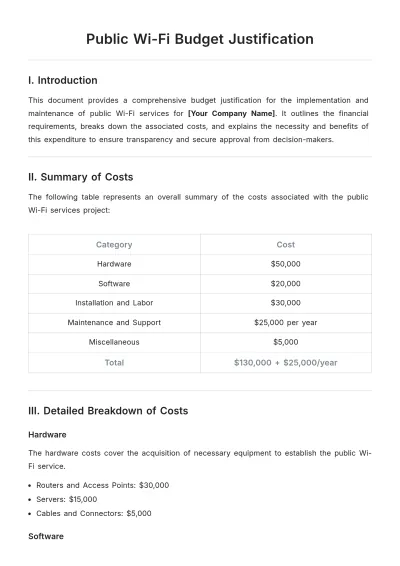
The following table represents an overall summary of the costs associated with the public Wi-Fi services project:
Category | Cost |
|---|---|
Hardware | $50,000 |
Software | $20,000 |
Installation and Labor | $30,000 |
Maintenance and Support | $25,000 per year |
Miscellaneous | $5,000 |
Total | $130,000 + $25,000/year |
III. Detailed Breakdown of Costs
Hardware
The hardware costs cover the acquisition of necessary equipment to establish the public Wi-Fi service.
Routers and Access Points: $30,000
Servers: $15,000
Cables and Connectors: $5,000
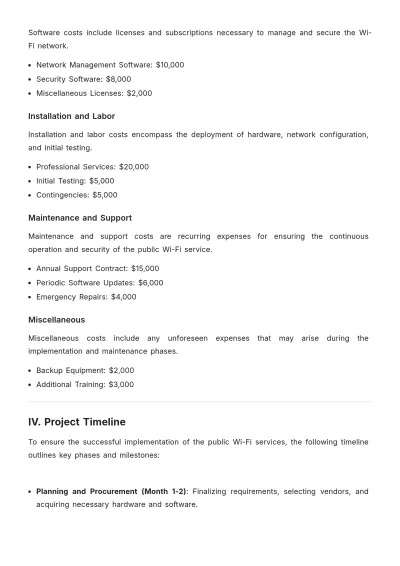
Software
Software costs include licenses and subscriptions necessary to manage and secure the Wi-Fi network.
Network Management Software: $10,000
Security Software: $8,000
Miscellaneous Licenses: $2,000
Installation and Labor
Installation and labor costs encompass the deployment of hardware, network configuration, and initial testing.
Professional Services: $20,000
Initial Testing: $5,000
Contingencies: $5,000
Maintenance and Support
Maintenance and support costs are recurring expenses for ensuring the continuous operation and security of the public Wi-Fi service.
Annual Support Contract: $15,000
Periodic Software Updates: $6,000
Emergency Repairs: $4,000
Miscellaneous
Miscellaneous costs include any unforeseen expenses that may arise during the implementation and maintenance phases.
Backup Equipment: $2,000
Additional Training: $3,000
IV. Project Timeline
To ensure the successful implementation of the public Wi-Fi services, the following timeline outlines key phases and milestones:
Planning and Procurement (Month 1-2): Finalizing requirements, selecting vendors, and acquiring necessary hardware and software.
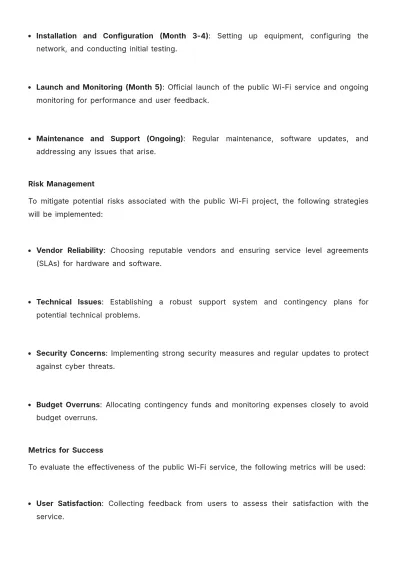
Installation and Configuration (Month 3-4): Setting up equipment, configuring the network, and conducting initial testing.
Launch and Monitoring (Month 5): Official launch of the public Wi-Fi service and ongoing monitoring for performance and user feedback.
Maintenance and Support (Ongoing): Regular maintenance, software updates, and addressing any issues that arise.
Risk Management
To mitigate potential risks associated with the public Wi-Fi project, the following strategies will be implemented:
Vendor Reliability: Choosing reputable vendors and ensuring service level agreements (SLAs) for hardware and software.
Technical Issues: Establishing a robust support system and contingency plans for potential technical problems.
Security Concerns: Implementing strong security measures and regular updates to protect against cyber threats.
Budget Overruns: Allocating contingency funds and monitoring expenses closely to avoid budget overruns.
Metrics for Success
To evaluate the effectiveness of the public Wi-Fi service, the following metrics will be used:
User Satisfaction: Collecting feedback from users to assess their satisfaction with the service.
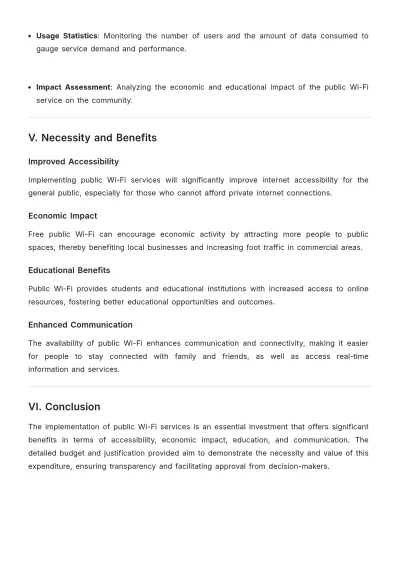
Usage Statistics: Monitoring the number of users and the amount of data consumed to gauge service demand and performance.
Impact Assessment: Analyzing the economic and educational impact of the public Wi-Fi service on the community.
V. Necessity and Benefits
Improved Accessibility
Implementing public Wi-Fi services will significantly improve internet accessibility for the general public, especially for those who cannot afford private internet connections.
Economic Impact
Free public Wi-Fi can encourage economic activity by attracting more people to public spaces, thereby benefiting local businesses and increasing foot traffic in commercial areas.
Educational Benefits
Public Wi-Fi provides students and educational institutions with increased access to online resources, fostering better educational opportunities and outcomes.
Enhanced Communication
The availability of public Wi-Fi enhances communication and connectivity, making it easier for people to stay connected with family and friends, as well as access real-time information and services.
VI. Conclusion
The implementation of public Wi-Fi services is an essential investment that offers significant benefits in terms of accessibility, economic impact, education, and communication. The detailed budget and justification provided aim to demonstrate the necessity and value of this expenditure, ensuring transparency and facilitating approval from decision-makers.
- 100% Customizable, free editor
- Access 1 Million+ Templates, photo’s & graphics
- Download or share as a template
- Click and replace photos, graphics, text, backgrounds
- Resize, crop, AI write & more
- Access advanced editor
Streamline your budgeting with the Public Wi-Fi Budget Justification Template from Template.net. Fully editable and customizable, this template helps you outline and justify your public Wi-Fi expenses effectively. Edit directly in our AI Editor Tool for a seamless experience. Perfect for detailed, professional budget proposals. Save time and ensure accuracy with ease!
You may also like
- Budget Sheet
- Personal Budget
- Non Profit Budget
- Monthly Budget
- Project Budget
- HR Budget
- Company Budget
- Home Budget
- Weekly Budget
- College Budget
- Business Budget
- Construction Budget
- Small Business Budget
- Hotel Budget
- Annual Budget
- Home Renovation Budget
- Household Budget
- Student Budget
- Grocery Budget
- Marketing Budget
- Corporate Budget
- Startup Budget
- Manufacturing Budget
- Church Budget
- University Budget
- Annual Budget Plan
- Event Budget
- Operating Budget
- Travel Budget
- Food Budget
- IT and Software Budget
- School Budget
- Real Estate Budget
- Sales Budget
- Conference Budget
- Budget Finance
- Freelancer Budget
- Budget Advertising