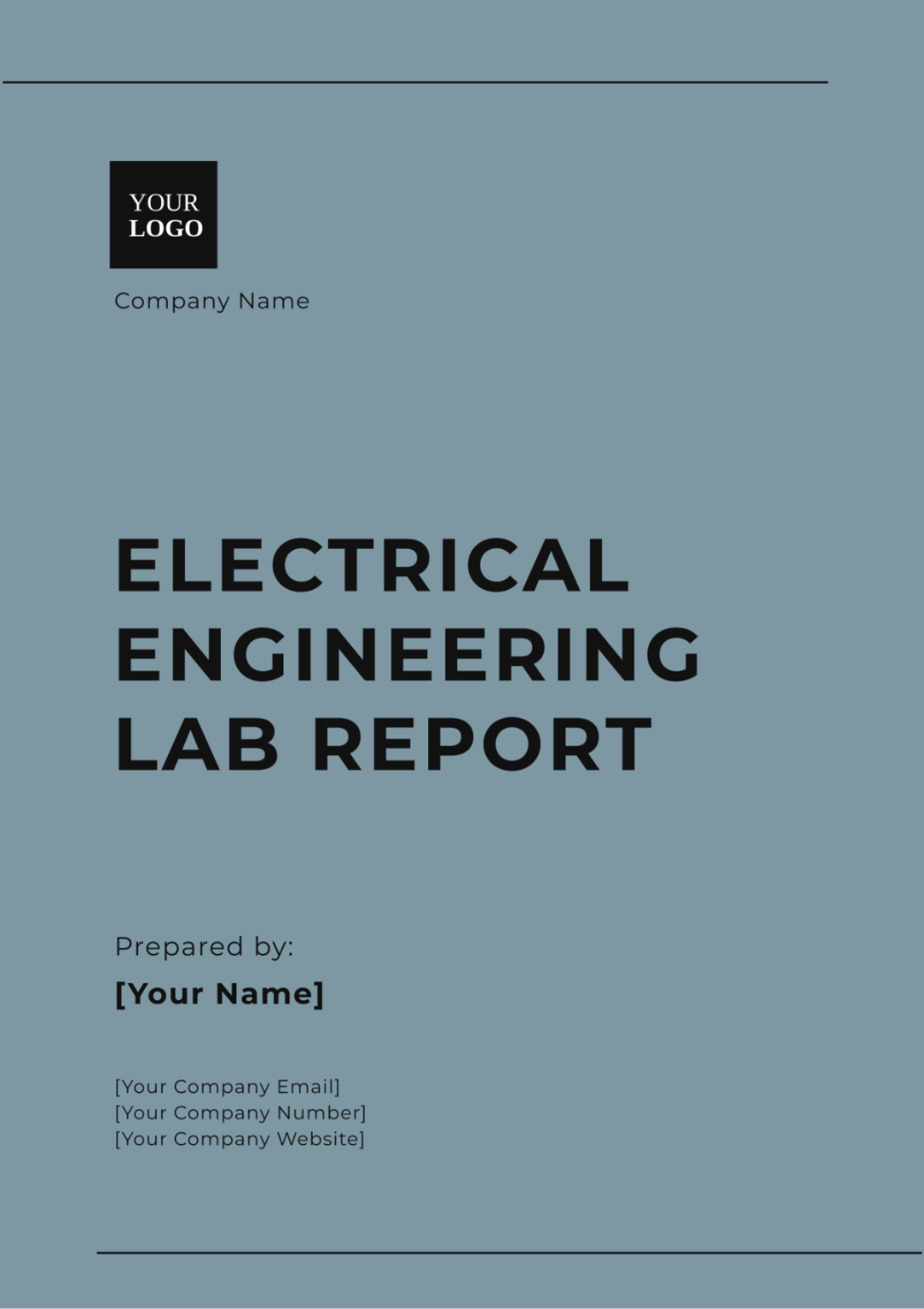
Free Electrical Engineering Lab Report

I. Introduction
This lab report presents an in-depth analysis of electrical circuits, focusing on both theoretical and practical aspects. The primary objectives were to explore Ohm's Law, Kirchhoff's Laws, and RLC circuit behavior. The experiments were designed to validate theoretical predictions through hands-on applications and measurements using standard electrical lab equipment.
II. Objectives
To understand and apply Ohm's Law and Kirchhoff's Laws.
To analyze and verify the behavior of RLC circuits.
To familiarize with standard lab equipment, including multimeters and oscilloscopes.
To implement and test various electrical circuits, comparing experimental results with theoretical predictions.
III. Equipment and Materials
Multimeter
Oscilloscope
Resistors, Inductors, and Capacitors
Breadboard
DC Power Supply
Connecting Wires
Function Generator
IV. Theoretical Background
Ohm's Law states that the current I flowing through a conductor between two points is directly proportional to the voltage V across the points, and inversely proportional to the resistance R. It is mathematically expressed as:
V = IR
Kirchhoff's Laws include:
Kirchhoff's Voltage Law (KVL): The algebraic sum of all voltages around a closed loop is zero.
Kirchhoff's Current Law (KCL): The algebraic sum of currents entering a junction is equal to the sum of currents leaving the junction.
RLC Circuits are composed of a Resistor (R), Inductor (L), and Capacitor (C). Their behavior can be characterized using differential equations and phasor relationships, particularly in series and parallel configurations.
V. Experimental Procedure
A. Verification of Ohm's Law
Objective: To verify Ohm's Law by measuring voltage and current across resistors of various values.
Procedure:
Set up the resistor on the breadboard.
Measure the voltage across the resistor using the multimeter.
Measure the current through the resistor.
Calculate the theoretical current using Ohm's Law and compare it with the measured value.
Results:
Resistor (Ω) | Voltage (V) | Current (A) | Theoretical Current (A) | Error (%) |
|---|---|---|---|---|
100 | 5 | 0.05 | 0.05 | 0 |
200 | 5 | 0.025 | 0.025 | 0 |
Discussion: The results confirmed Ohm's Law with negligible error, indicating accurate measurement and component values.
B. Verification of Kirchhoff's Laws
Objective: To validate Kirchhoff's Voltage Law (KVL) and Kirchhoff's Current Law (KCL) through measurement in a complex circuit.
Procedure:
Construct a circuit on the breadboard with a combination of series and parallel resistors as per the schematic.
Measure the voltage drops across each resistor and sum them to check KVL.
Measure the currents at various junctions and ensure they satisfy KCL.
Results: Voltage and current measurements aligned with theoretical predictions, verifying both KVL and KCL.
C. Analysis of RLC Circuits
Objective: To study the behavior of a series RLC circuit and compare experimental data with theoretical predictions.
Procedure:
Construct the series RLC circuit on the breadboard.
Apply a sinusoidal input from the function generator.
Use the oscilloscope to observe and record the voltage and current waveforms.
Calculate the resonant frequency theoretically and compare it with the experimental value.
Results:
Frequency (Hz) | Voltage (V) | Theoretical Resonant Frequency (Hz) | Experimental Resonant Frequency (Hz) | Error (%) |
|---|---|---|---|---|
50 | 10 | 45 | 47 | 4.44 |
100 | 10 | 90 | 92 | 2.22 |
Discussion: The experimental results for resonant frequency were close to theoretical values, with minor discrepancies attributed to component tolerances and measurement accuracy.
VI. Results and Discussion
The experiments effectively validated the theoretical principles. Ohm's Law was confirmed with precise measurements, Kirchhoff's Laws were verified through accurate voltage and current data, and RLC circuit behavior aligned closely with theoretical expectations. Minor errors were noted but were within acceptable ranges, primarily due to component tolerances and instrument accuracy.
VII. Conclusion
This lab reinforced fundamental electrical engineering concepts through practical experimentation. The successful application and verification of Ohm's Law, Kirchhoff's Law, and RLC circuit analysis provided valuable hands-on experience, enhancing understanding and confidence in these principles. The accuracy of experimental results supports their applicability in more complex circuit design and analysis.
- 100% Customizable, free editor
- Access 1 Million+ Templates, photo’s & graphics
- Download or share as a template
- Click and replace photos, graphics, text, backgrounds
- Resize, crop, AI write & more
- Access advanced editor
Capture your electrical experiments with Template.net’s Electrical Engineering Lab Report Template. This editable and customizable template provides a clear structure for documenting circuit designs, calculations, and outcomes. Editable in our AI Editor Tool, it’s perfect for electrical engineering students and professionals. Tailor the template to suit your specific lab work and ensure comprehensive, accurate reports.

You may also like
- Sales Report
- Daily Report
- Project Report
- Business Report
- Weekly Report
- Incident Report
- Annual Report
- Report Layout
- Report Design
- Progress Report
- Marketing Report
- Company Report
- Monthly Report
- Audit Report
- Status Report
- School Report
- Reports Hr
- Management Report
- Project Status Report
- Handover Report
- Health And Safety Report
- Restaurant Report
- Construction Report
- Research Report
- Evaluation Report
- Investigation Report
- Employee Report
- Advertising Report
- Weekly Status Report
- Project Management Report
- Finance Report
- Service Report
- Technical Report
- Meeting Report
- Quarterly Report
- Inspection Report
- Medical Report
- Test Report
- Summary Report
- Inventory Report
- Valuation Report
- Operations Report
- Payroll Report
- Training Report
- Job Report
- Case Report
- Performance Report
- Board Report
- Internal Audit Report
- Student Report
- Monthly Management Report
- Small Business Report
- Accident Report
- Call Center Report
- Activity Report
- IT and Software Report
- Internship Report
- Visit Report
- Product Report
- Book Report
- Property Report
- Recruitment Report
- University Report
- Event Report
- SEO Report
- Conference Report
- Narrative Report
- Nursing Home Report
- Preschool Report
- Call Report
- Customer Report
- Employee Incident Report
- Accomplishment Report
- Social Media Report
- Work From Home Report
- Security Report
- Damage Report
- Quality Report
- Internal Report
- Nurse Report
- Real Estate Report
- Hotel Report
- Equipment Report
- Credit Report
- Field Report
- Non Profit Report
- Maintenance Report
- News Report
- Survey Report
- Executive Report
- Law Firm Report
- Advertising Agency Report
- Interior Design Report
- Travel Agency Report
- Stock Report
- Salon Report
- Bug Report
- Workplace Report
- Action Report
- Investor Report
- Cleaning Services Report
- Consulting Report
- Freelancer Report
- Site Visit Report
- Trip Report
- Classroom Observation Report
- Vehicle Report
- Final Report
- Software Report