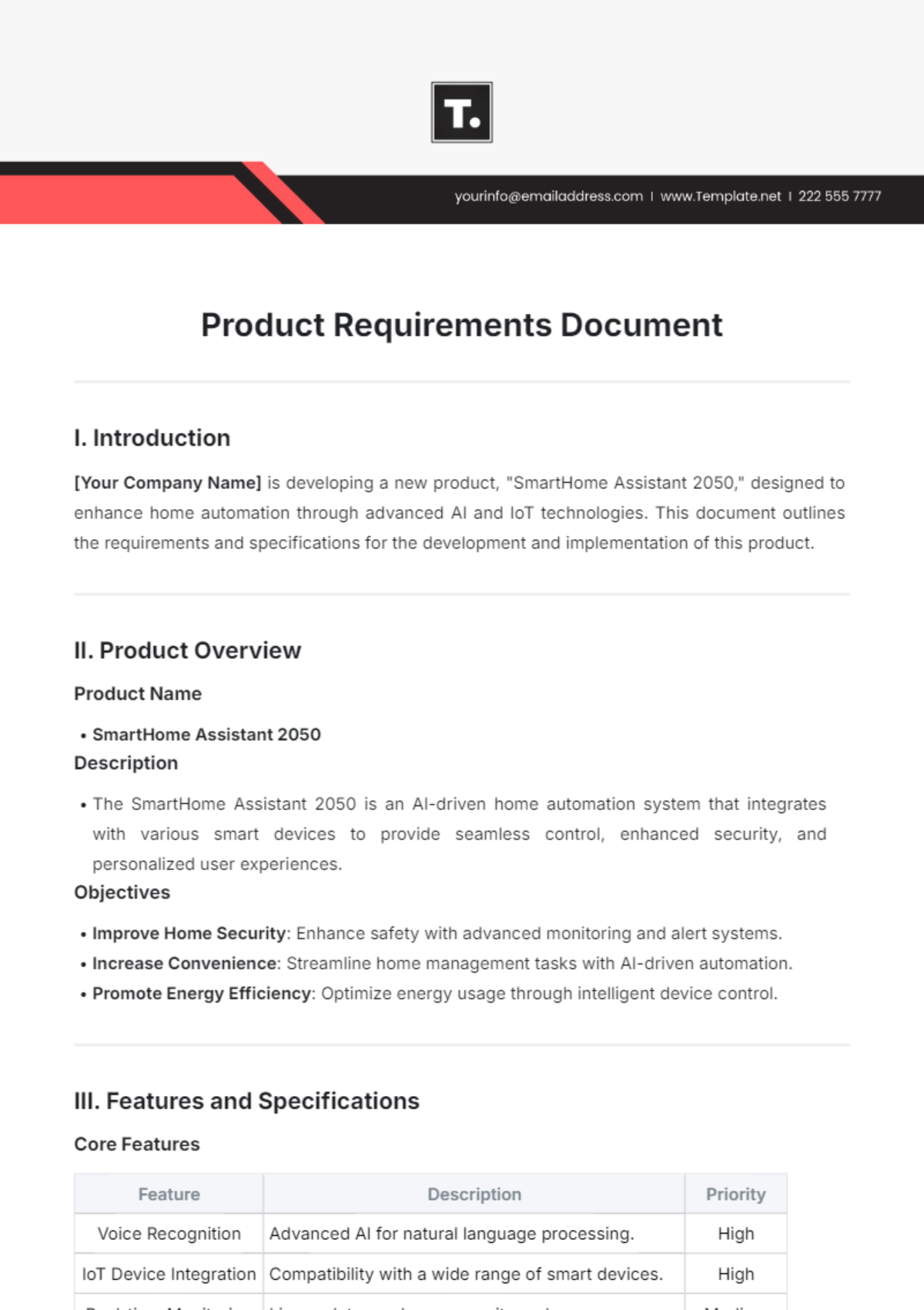
Product Requirements Document
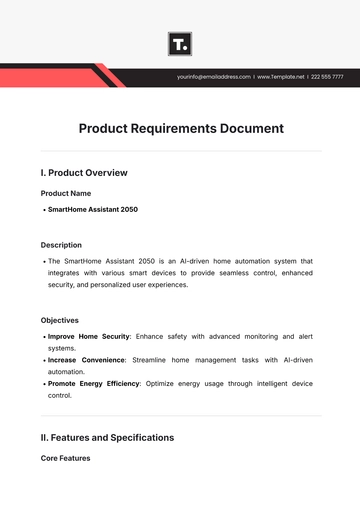
I. Product Overview
Product Name
Description
Objectives
Improve Home Security: Enhance safety with advanced monitoring and alert systems.
Increase Convenience: Streamline home management tasks with AI-driven automation.
Promote Energy Efficiency: Optimize energy usage through intelligent device control.
II. Features and Specifications
Core Features
Feature | Description | Priority |
|---|
Voice Recognition | Advanced AI for natural language processing. | High |
IoT Device Integration | Compatibility with a wide range of smart devices. | High |
Real-time Monitoring | Live updates on home security and energy usage. | Medium |
Customizable Settings | User-defined preferences for automation. | High |
Energy Reports | Detailed analysis of energy consumption. | Low |
Technical Specifications
Operating System: Custom Linux-based OS
Connectivity: Wi-Fi 6, Bluetooth 5.3, Zigbee
Power Supply: AC 100-240V, 50/60Hz
Dimensions: 150mm x 150mm x 50mm
Weight: 300g
III. User Interface Design
Dashboard
Home Screen: Overview of current system status and notifications.
Settings: Customization options for automation and device control.
Reports: Access to energy consumption and security reports.
Mobile App
IV. Integration and Compatibility
Supported Devices
Smart Lights: Philips Hue, LIFX
Thermostats: Nest, Ecobee
Security Cameras: Arlo, Ring
APIs
V. Testing and Validation
Testing Phases
Phase | Description | Duration |
|---|
Alpha Testing | Initial testing of core features and functionality. | 2 weeks |
Beta Testing | Expanded testing with selected users. | 4 weeks |
User Acceptance Testing | Final validation with target user groups. | 3 weeks |
Validation Criteria
Functionality: All core features must work as specified.
Usability: The interface must be intuitive and user-friendly.
Performance: The system must perform reliably under expected load.
VI. Deployment and Support
Deployment Plan
Support
VII. Appendices
Contact Information
References