Free Agricultural Field Site Report

Introduction
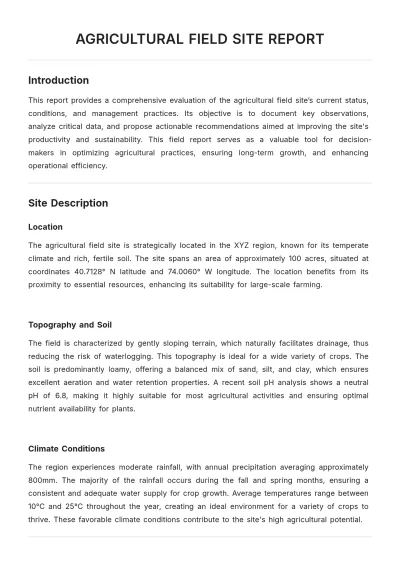
This report provides a comprehensive evaluation of the agricultural field site’s current status, conditions, and management practices. Its objective is to document key observations, analyze critical data, and propose actionable recommendations aimed at improving the site's productivity and sustainability. This field report serves as a valuable tool for decision-makers in optimizing agricultural practices, ensuring long-term growth, and enhancing operational efficiency.
Site Description
Location
The agricultural field site is strategically located in the XYZ region, known for its temperate climate and rich, fertile soil. The site spans an area of approximately 100 acres, situated at coordinates 40.7128° N latitude and 74.0060° W longitude. The location benefits from its proximity to essential resources, enhancing its suitability for large-scale farming.
Topography and Soil
The field is characterized by gently sloping terrain, which naturally facilitates drainage, thus reducing the risk of waterlogging. This topography is ideal for a wide variety of crops. The soil is predominantly loamy, offering a balanced mix of sand, silt, and clay, which ensures excellent aeration and water retention properties. A recent soil pH analysis shows a neutral pH of 6.8, making it highly suitable for most agricultural activities and ensuring optimal nutrient availability for plants.
Climate Conditions
The region experiences moderate rainfall, with annual precipitation averaging approximately 800mm. The majority of the rainfall occurs during the fall and spring months, ensuring a consistent and adequate water supply for crop growth. Average temperatures range between 10°C and 25°C throughout the year, creating an ideal environment for a variety of crops to thrive. These favorable climate conditions contribute to the site's high agricultural potential.
Agricultural Practices
Crop Rotation
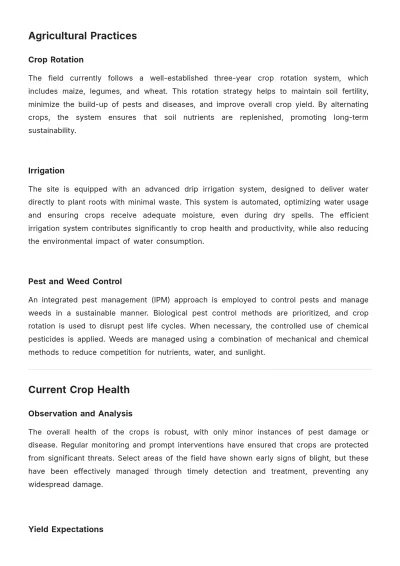
The field currently follows a well-established three-year crop rotation system, which includes maize, legumes, and wheat. This rotation strategy helps to maintain soil fertility, minimize the build-up of pests and diseases, and improve overall crop yield. By alternating crops, the system ensures that soil nutrients are replenished, promoting long-term sustainability.
Irrigation
The site is equipped with an advanced drip irrigation system, designed to deliver water directly to plant roots with minimal waste. This system is automated, optimizing water usage and ensuring crops receive adequate moisture, even during dry spells. The efficient irrigation system contributes significantly to crop health and productivity, while also reducing the environmental impact of water consumption.
Pest and Weed Control
An integrated pest management (IPM) approach is employed to control pests and manage weeds in a sustainable manner. Biological pest control methods are prioritized, and crop rotation is used to disrupt pest life cycles. When necessary, the controlled use of chemical pesticides is applied. Weeds are managed using a combination of mechanical and chemical methods to reduce competition for nutrients, water, and sunlight.
Current Crop Health
Observation and Analysis
The overall health of the crops is robust, with only minor instances of pest damage or disease. Regular monitoring and prompt interventions have ensured that crops are protected from significant threats. Select areas of the field have shown early signs of blight, but these have been effectively managed through timely detection and treatment, preventing any widespread damage.
Yield Expectations
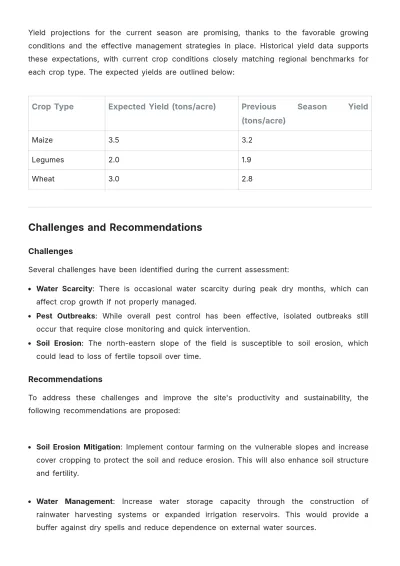
Yield projections for the current season are promising, thanks to the favorable growing conditions and the effective management strategies in place. Historical yield data supports these expectations, with current crop conditions closely matching regional benchmarks for each crop type. The expected yields are outlined below:
Crop Type | Expected Yield (tons/acre) | Previous Season Yield (tons/acre) |
|---|---|---|
Maize | 3.5 | 3.2 |
Legumes | 2.0 | 1.9 |
Wheat | 3.0 | 2.8 |
Challenges and Recommendations
Challenges
Several challenges have been identified during the current assessment:
Water Scarcity: There is occasional water scarcity during peak dry months, which can affect crop growth if not properly managed.
Pest Outbreaks: While overall pest control has been effective, isolated outbreaks still occur that require close monitoring and quick intervention.
Soil Erosion: The north-eastern slope of the field is susceptible to soil erosion, which could lead to loss of fertile topsoil over time.
Recommendations
To address these challenges and improve the site's productivity and sustainability, the following recommendations are proposed:
Soil Erosion Mitigation: Implement contour farming on the vulnerable slopes and increase cover cropping to protect the soil and reduce erosion. This will also enhance soil structure and fertility.
Water Management: Increase water storage capacity through the construction of rainwater harvesting systems or expanded irrigation reservoirs. This would provide a buffer against dry spells and reduce dependence on external water sources.
Integrated Pest Management (IPM) Enhancement: Continue to strengthen the IPM approach by introducing additional natural predators, such as beneficial insects, and experimenting with resistant crop varieties to reduce vulnerability to pests.
Diversification: Consider diversifying the crops grown to include drought-resistant or high-value crops that can withstand variable climate conditions and market demands.
Conclusion
In conclusion, the agricultural field site demonstrates healthy and sustainable farming practices, with a promising outlook for the current season’s yields. By addressing the identified challenges—such as water scarcity, pest outbreaks, and soil erosion—the site can further improve its resilience and productivity. Ongoing monitoring, adaptation to changing environmental conditions, and the implementation of recommended improvements will ensure the continued success and sustainability of the agricultural operation.
- 100% Customizable, free editor
- Access 1 Million+ Templates, photo’s & graphics
- Download or share as a template
- Click and replace photos, graphics, text, backgrounds
- Resize, crop, AI write & more
- Access advanced editor
The Agricultural Field Site Report Template, offered by Template.net, is a fully customizable and editable tool designed to streamline your site assessments. This downloadable template allows you to input critical data easily and efficiently, helping you create detailed reports for agricultural projects. With its printable format, you can have physical copies of your reports in no time. Edit the template in our AI Editor Tool for quick updates and improvements, ensuring a professional and personalized touch every time. Perfect for field assessments, this template will save you time and effort while keeping your reports organized.
You may also like
- Sales Report
- Daily Report
- Project Report
- Business Report
- Weekly Report
- Incident Report
- Annual Report
- Report Layout
- Report Design
- Progress Report
- Marketing Report
- Company Report
- Monthly Report
- Audit Report
- Status Report
- School Report
- Reports Hr
- Management Report
- Project Status Report
- Handover Report
- Health And Safety Report
- Restaurant Report
- Construction Report
- Research Report
- Evaluation Report
- Investigation Report
- Employee Report
- Advertising Report
- Weekly Status Report
- Project Management Report
- Finance Report
- Service Report
- Technical Report
- Meeting Report
- Quarterly Report
- Inspection Report
- Medical Report
- Test Report
- Summary Report
- Inventory Report
- Valuation Report
- Operations Report
- Payroll Report
- Training Report
- Job Report
- Case Report
- Performance Report
- Board Report
- Internal Audit Report
- Student Report
- Monthly Management Report
- Small Business Report
- Accident Report
- Call Center Report
- Activity Report
- IT and Software Report
- Internship Report
- Visit Report
- Product Report
- Book Report
- Property Report
- Recruitment Report
- University Report
- Event Report
- SEO Report
- Conference Report
- Narrative Report
- Nursing Home Report
- Preschool Report
- Call Report
- Customer Report
- Employee Incident Report
- Accomplishment Report
- Social Media Report
- Work From Home Report
- Security Report
- Damage Report
- Quality Report
- Internal Report
- Nurse Report
- Real Estate Report
- Hotel Report
- Equipment Report
- Credit Report
- Field Report
- Non Profit Report
- Maintenance Report
- News Report
- Survey Report
- Executive Report
- Law Firm Report
- Advertising Agency Report
- Interior Design Report
- Travel Agency Report
- Stock Report
- Salon Report
- Bug Report
- Workplace Report
- Action Report
- Investor Report
- Cleaning Services Report
- Consulting Report
- Freelancer Report
- Site Visit Report
- Trip Report
- Classroom Observation Report
- Vehicle Report
- Final Report
- Software Report