Free Accounting Asset Inventory Program

Introduction
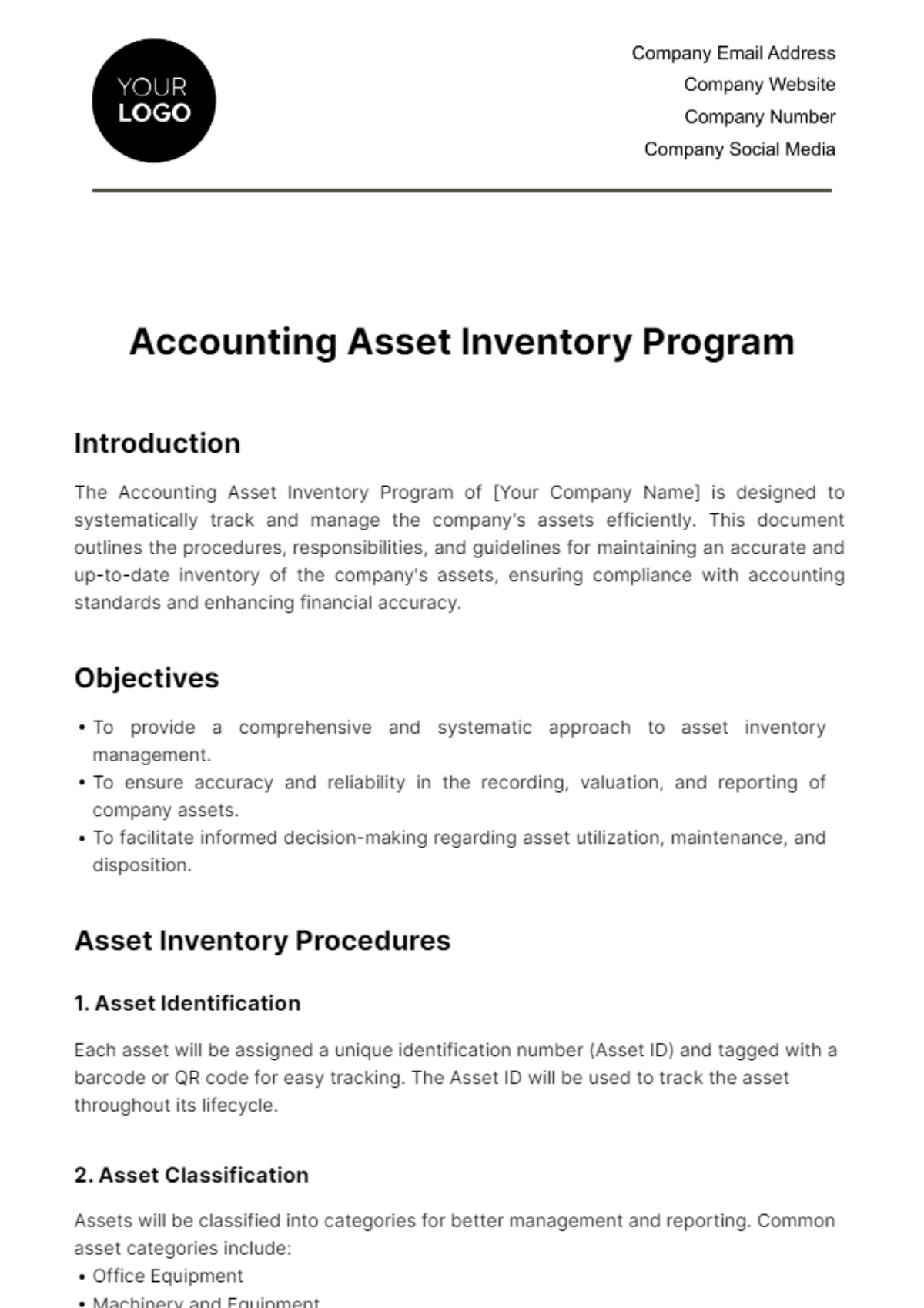
The Accounting Asset Inventory Program of [Your Company Name] is designed to systematically track and manage the company's assets efficiently. This document outlines the procedures, responsibilities, and guidelines for maintaining an accurate and up-to-date inventory of the company's assets, ensuring compliance with accounting standards and enhancing financial accuracy.
Objectives
To provide a comprehensive and systematic approach to asset inventory management.
To ensure accuracy and reliability in the recording, valuation, and reporting of company assets.
To facilitate informed decision-making regarding asset utilization, maintenance, and disposition.
Asset Inventory Procedures
1. Asset Identification
Each asset will be assigned a unique identification number (Asset ID) and tagged with a barcode or QR code for easy tracking. The Asset ID will be used to track the asset throughout its lifecycle.
2. Asset Classification
Assets will be classified into categories for better management and reporting. Common asset categories include:
Office Equipment
Machinery and Equipment
Vehicles
Furniture and Fixtures
Computer Hardware and Software
Buildings and Land
3. Asset Registration
All assets must be registered in the Asset Inventory Register upon acquisition. The register will include the following details:
Asset ID
Description
Category
Date of Acquisition
Cost
Location
Condition
Depreciation Method
Useful Life
Residual Value
4. Asset Tracking
Assets will be regularly tracked for location, condition, and status updates. Asset transfers and disposals must be recorded immediately in the Asset Inventory Register.
5. Physical Inventory Count
A physical inventory count will be conducted annually to verify the accuracy of the Asset Inventory Register. Discrepancies will be investigated and resolved promptly.
6. Depreciation Calculation
Depreciation will be calculated annually for all depreciable assets using the straight-line method, based on the useful life and residual value of each asset.
7. Reporting
Asset inventory reports will be generated annually and include information on asset additions, disposals, depreciation, and net book value.
Responsibilities
Finance Department: | Oversee the asset inventory program, maintain the Asset Inventory Register, calculate depreciation, and prepare annual reports. |
Department Managers: | Ensure the proper use and maintenance of assets within their departments, report any asset disposals or transfers, and assist in the physical inventory count. |
IT Department: | Support the implementation of asset tracking technologies and maintain the asset inventory software. |
Conclusion
The Accounting Asset Inventory Program is a critical component of [Your Company Name]'s financial management strategy. By maintaining an accurate and up-to-date inventory of assets, the company can ensure financial integrity, support strategic decision-making, and comply with accounting standards and regulations.
- 100% Customizable, free editor
- Access 1 Million+ Templates, photo’s & graphics
- Download or share as a template
- Click and replace photos, graphics, text, backgrounds
- Resize, crop, AI write & more
- Access advanced editor
Introducing the Accounting Asset Inventory Program Template from Template.net, a meticulously crafted tool designed to assist in the accurate tracking and management of assets. Fully editable and customizable, this template adapts seamlessly to your organization's requirements, offering a structured approach to asset inventory. A must-have for finance professionals who can now edit the template using our Ai Editor Tool at Template.net.