Free Educational Bylaws

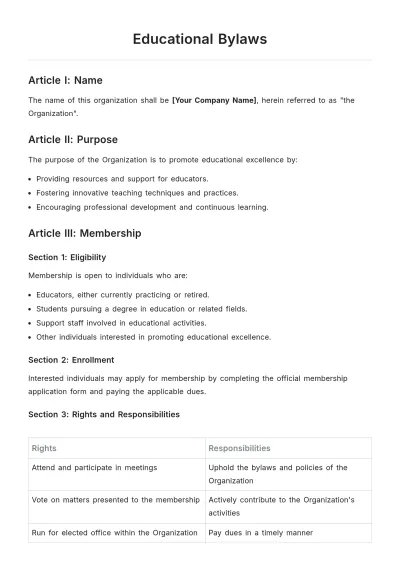
Article I: Name
The name of this organization shall be [Your Company Name], herein referred to as "the Organization".
Article II: Purpose
The purpose of the Organization is to promote educational excellence by:
Providing resources and support for educators.
Fostering innovative teaching techniques and practices.
Encouraging professional development and continuous learning.
Article III: Membership
Section 1: Eligibility
Membership is open to individuals who are:
Educators, either currently practicing or retired.
Students pursuing a degree in education or related fields.
Support staff involved in educational activities.
Other individuals interested in promoting educational excellence.
Section 2: Enrollment
Interested individuals may apply for membership by completing the official membership application form and paying the applicable dues.
Section 3: Rights and Responsibilities
Rights | Responsibilities |
|---|---|
Attend and participate in meetings | Uphold the bylaws and policies of the Organization |
Vote on matters presented to the membership | Actively contribute to the Organization's activities |
Run for elected office within the Organization | Pay dues in a timely manner |
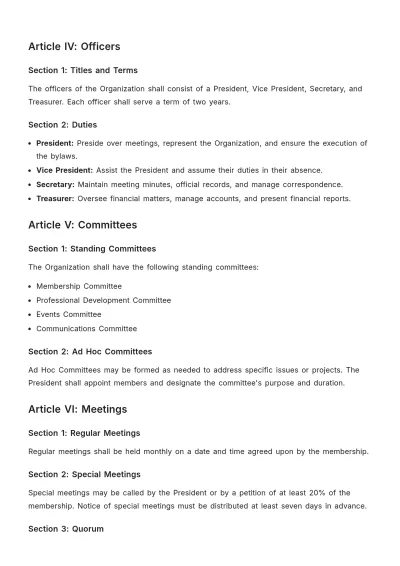
Article IV: Officers
Section 1: Titles and Terms
The officers of the Organization shall consist of a President, Vice President, Secretary, and Treasurer. Each officer shall serve a term of two years.
Section 2: Duties
President: Preside over meetings, represent the Organization, and ensure the execution of the bylaws.
Vice President: Assist the President and assume their duties in their absence.
Secretary: Maintain meeting minutes, official records, and manage correspondence.
Treasurer: Oversee financial matters, manage accounts, and present financial reports.
Article V: Committees
Section 1: Standing Committees
The Organization shall have the following standing committees:
Membership Committee
Professional Development Committee
Events Committee
Communications Committee
Section 2: Ad Hoc Committees
Ad Hoc Committees may be formed as needed to address specific issues or projects. The President shall appoint members and designate the committee's purpose and duration.
Article VI: Meetings
Section 1: Regular Meetings
Regular meetings shall be held monthly on a date and time agreed upon by the membership.
Section 2: Special Meetings
Special meetings may be called by the President or by a petition of at least 20% of the membership. Notice of special meetings must be distributed at least seven days in advance.
Section 3: Quorum
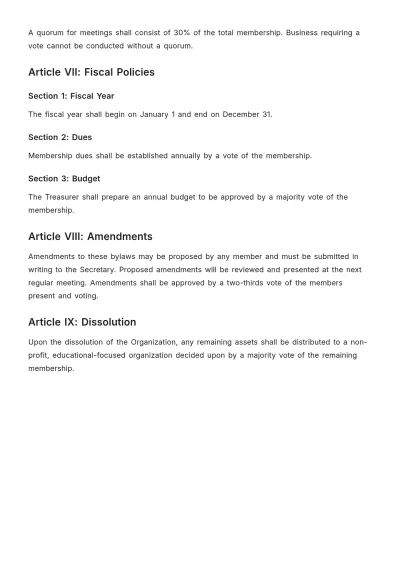
A quorum for meetings shall consist of 30% of the total membership. Business requiring a vote cannot be conducted without a quorum.
Article VII: Fiscal Policies
Section 1: Fiscal Year
The fiscal year shall begin on January 1 and end on December 31.
Section 2: Dues
Membership dues shall be established annually by a vote of the membership.
Section 3: Budget
The Treasurer shall prepare an annual budget to be approved by a majority vote of the membership.
Article VIII: Amendments
Amendments to these bylaws may be proposed by any member and must be submitted in writing to the Secretary. Proposed amendments will be reviewed and presented at the next regular meeting. Amendments shall be approved by a two-thirds vote of the members present and voting.
Article IX: Dissolution
Upon the dissolution of the Organization, any remaining assets shall be distributed to a non-profit, educational-focused organization decided upon by a majority vote of the remaining membership.
- 100% Customizable, free editor
- Access 1 Million+ Templates, photo’s & graphics
- Download or share as a template
- Click and replace photos, graphics, text, backgrounds
- Resize, crop, AI write & more
- Access advanced editor
Set up a strong governance framework for educational institutions with this customizable Educational Bylaws Template that is found exclusively at Template.net. Editable in our intuitive Ai Editor Tool, this template provides a clear and adaptable structure, ensuring that your institution's bylaws align with educational policies, legal standards, and operational goals.