Free How to Write a Software Test Plan

Prepared by: [Your Name]
I. Introduction
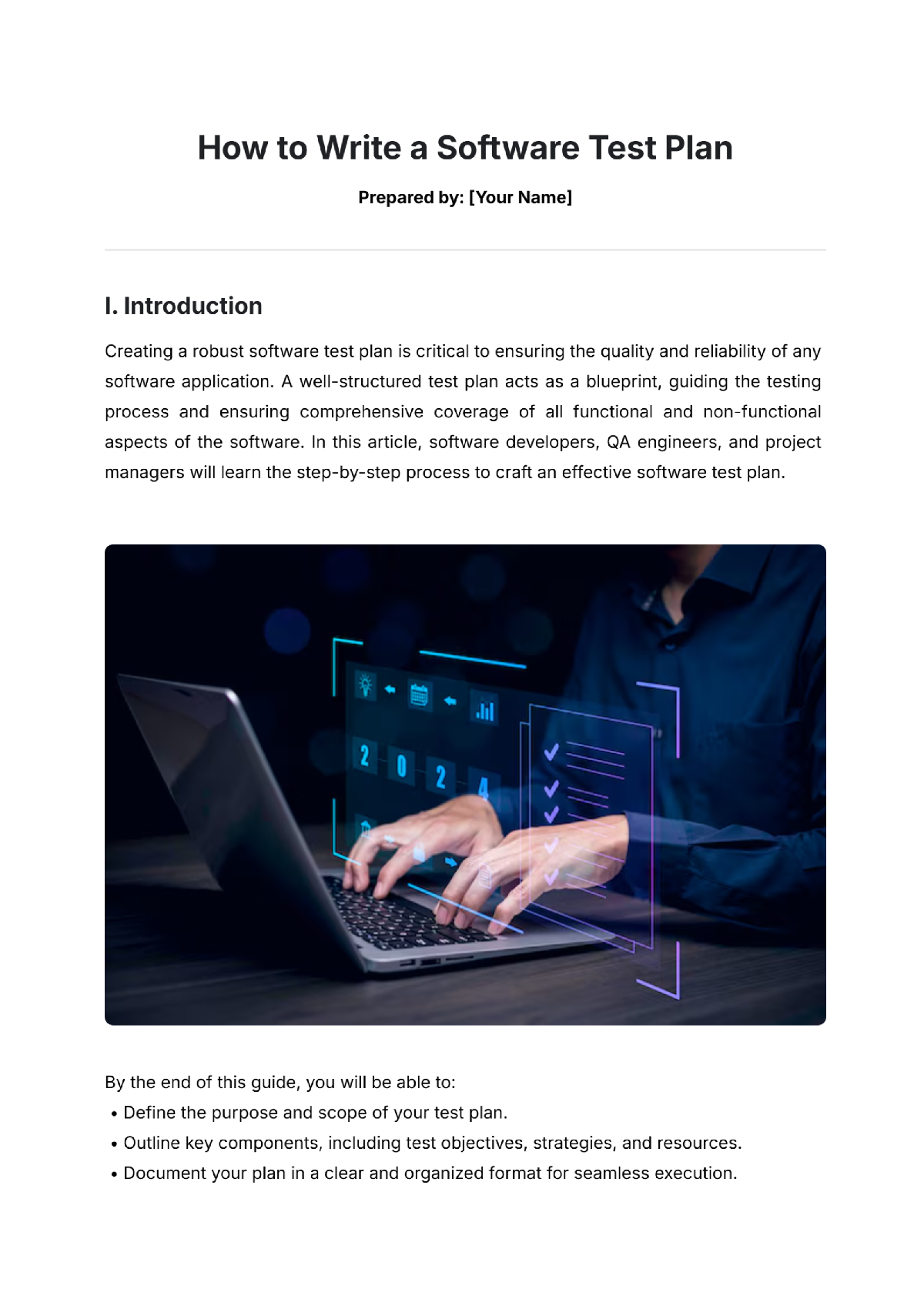
Creating a robust software test plan is critical to ensuring the quality and reliability of any software application. A well-structured test plan acts as a blueprint, guiding the testing process and ensuring comprehensive coverage of all functional and non-functional aspects of the software. In this article, software developers, QA engineers, and project managers will learn the step-by-step process to craft an effective software test plan.

By the end of this guide, you will be able to:
Define the purpose and scope of your test plan.
Outline key components, including test objectives, strategies, and resources.
Document your plan in a clear and organized format for seamless execution.
II. What is a Software Test Plan?
A software test plan is a document that outlines the scope, objectives, approach, and resources needed to validate the quality of a software application. It serves as a communication tool among stakeholders, helping to align expectations and clarify testing responsibilities.
Key Benefits of a Test Plan
Clear Communication: Bridges the gap between development and QA teams.
Risk Mitigation: Identifies potential risks and outlines mitigation strategies.
Streamlined Execution: Provides a structured approach to testing for predictable results.
For instance, if your team is working on FutureApp 2050, a comprehensive test plan ensures that all critical functionalities are tested before deployment.
III. Steps to Write a Software Test Plan
Step 1: Define the Purpose and Scope
Clearly articulate the purpose of the test plan. Answer questions such as:
What are the goals of this testing process?
What features and functionalities are in scope or out of scope?
Example:
Purpose: Ensure FutureApp 2050’s data visualization dashboard works as expected under various scenarios.
Scope: Includes testing user interface responsiveness and data accuracy. Excludes testing third-party integrations at this stage.
Step 2: Identify Test Objectives
List out the specific objectives of the testing effort. These could include:
Validating user inputs and outputs.
Ensuring compatibility across holographic and traditional interfaces.
Testing system performance under AI-driven load.
Step 3: Develop a Testing Strategy
Outline the approach you’ll use to achieve the test objectives:
Testing Levels: Unit, Integration, System, and User Acceptance Testing.
Test Types: Manual vs. Automated Testing.
Tools: Specify tools like 2050 TestManager Pro for execution and reporting.
Step 4: Allocate Resources and Assign Roles
Define the team’s structure and responsibilities:
Role | Responsibilities |
|---|---|
QA Lead | Oversees the entire testing process. |
Test Engineer | Executes test cases and logs defects. |
AI Assistant | Automates repetitive test scenarios. |
Step 5: Document the Test Environment
Clearly specify the test environment details:
Hardware Requirements: Quantum Processor v3.0, 256-core setups.
Software Requirements: GenOS 50, DataFlux DB 10.5.
Network Configuration: NeuralNet Cloud Access, SecureKey VPN.
IV. Writing the Test Cases
Test cases are the backbone of any software test plan. Ensure they include:

Test Case ID: Unique identifier, e.g., TC205001.
Description: Brief description of the test case.
Steps to Execute: A detailed step-by-step guide.
Expected Result: The outcome the test aims to validate.
Example Test Case Table:
Test Case ID | Description | Steps to Execute | Expected Result |
|---|---|---|---|
TC205001 | Validate login UI | Input valid credentials. | Successful login and redirect. |
TC205002 | Test performance load | Simulate 10,000 AI-driven users. | No slowdown or crashes observed. |
V. Test Plan Checklist
Before finalizing your software test plan, review this checklist:
Have all test objectives been clearly defined?
Are testing strategies and tools appropriate for the project?
Has the test environment been set up and documented?
Are roles and responsibilities assigned?
VI. Conclusion
A comprehensive test plan ensures that the testing process is efficient, organized, and aligned with project goals. By following this guide, you can craft a test plan that enhances the quality and reliability of FutureApp 2050.
For further insights or questions, feel free to contact [Your Name] at [Your Email].
Start building your test plan today to guarantee the success of your software project!
- 100% Customizable, free editor
- Access 1 Million+ Templates, photo’s & graphics
- Download or share as a template
- Click and replace photos, graphics, text, backgrounds
- Resize, crop, AI write & more
- Access advanced editor
Learn the essentials with Template.net’s guide on “How to Write a Software Test Plan.” Customizable and editable, this template offers a step-by-step framework for creating professional test plans. Editable in our AI Editor Tool, it’s perfect for beginners or experts. Download this guide to craft comprehensive and effective software test plans with ease.