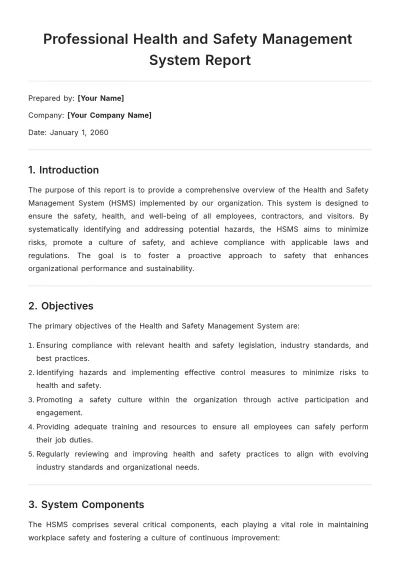
Free Professional Health and Safety Management System Report

Prepared by: [Your Name]
Company: [Your Company Name]
Date: January 1, 2060
1. Introduction
The purpose of this report is to provide a comprehensive overview of the Health and Safety Management System (HSMS) implemented by our organization. This system is designed to ensure the safety, health, and well-being of all employees, contractors, and visitors. By systematically identifying and addressing potential hazards, the HSMS aims to minimize risks, promote a culture of safety, and achieve compliance with applicable laws and regulations. The goal is to foster a proactive approach to safety that enhances organizational performance and sustainability.
2. Objectives
The primary objectives of the Health and Safety Management System are:
Ensuring compliance with relevant health and safety legislation, industry standards, and best practices.
Identifying hazards and implementing effective control measures to minimize risks to health and safety.
Promoting a safety culture within the organization through active participation and engagement.
Providing adequate training and resources to ensure all employees can safely perform their job duties.
Regularly reviewing and improving health and safety practices to align with evolving industry standards and organizational needs.
3. System Components
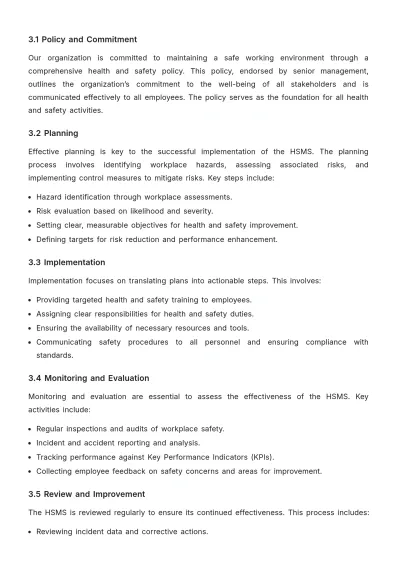
The HSMS comprises several critical components, each playing a vital role in maintaining workplace safety and fostering a culture of continuous improvement:
3.1 Policy and Commitment
Our organization is committed to maintaining a safe working environment through a comprehensive health and safety policy. This policy, endorsed by senior management, outlines the organization’s commitment to the well-being of all stakeholders and is communicated effectively to all employees. The policy serves as the foundation for all health and safety activities.
3.2 Planning
Effective planning is key to the successful implementation of the HSMS. The planning process involves identifying workplace hazards, assessing associated risks, and implementing control measures to mitigate risks. Key steps include:
Hazard identification through workplace assessments.
Risk evaluation based on likelihood and severity.
Setting clear, measurable objectives for health and safety improvement.
Defining targets for risk reduction and performance enhancement.
3.3 Implementation
Implementation focuses on translating plans into actionable steps. This involves:
Providing targeted health and safety training to employees.
Assigning clear responsibilities for health and safety duties.
Ensuring the availability of necessary resources and tools.
Communicating safety procedures to all personnel and ensuring compliance with standards.
3.4 Monitoring and Evaluation
Monitoring and evaluation are essential to assess the effectiveness of the HSMS. Key activities include:
Regular inspections and audits of workplace safety.
Incident and accident reporting and analysis.
Tracking performance against Key Performance Indicators (KPIs).
Collecting employee feedback on safety concerns and areas for improvement.
3.5 Review and Improvement
The HSMS is reviewed regularly to ensure its continued effectiveness. This process includes:
Reviewing incident data and corrective actions.
Evaluating the success of control measures and safety training.
Updating procedures to reflect changes in legislation, technology, or workplace conditions.
Incorporating lessons learned from past incidents to strengthen future safety practices.
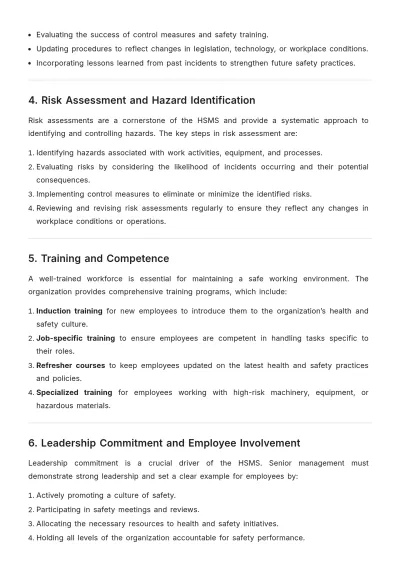
4. Risk Assessment and Hazard Identification
Risk assessments are a cornerstone of the HSMS and provide a systematic approach to identifying and controlling hazards. The key steps in risk assessment are:
Identifying hazards associated with work activities, equipment, and processes.
Evaluating risks by considering the likelihood of incidents occurring and their potential consequences.
Implementing control measures to eliminate or minimize the identified risks.
Reviewing and revising risk assessments regularly to ensure they reflect any changes in workplace conditions or operations.
5. Training and Competence
A well-trained workforce is essential for maintaining a safe working environment. The organization provides comprehensive training programs, which include:
Induction training for new employees to introduce them to the organization’s health and safety culture.
Job-specific training to ensure employees are competent in handling tasks specific to their roles.
Refresher courses to keep employees updated on the latest health and safety practices and policies.
Specialized training for employees working with high-risk machinery, equipment, or hazardous materials.
6. Leadership Commitment and Employee Involvement
Leadership commitment is a crucial driver of the HSMS. Senior management must demonstrate strong leadership and set a clear example for employees by:
Actively promoting a culture of safety.
Participating in safety meetings and reviews.
Allocating the necessary resources to health and safety initiatives.
Holding all levels of the organization accountable for safety performance.
Employee involvement is equally important in achieving a successful HSMS. Encouraging participation in safety initiatives ensures that safety concerns are identified early and that safety practices are continuously improved. Employees are encouraged to report hazards, suggest improvements, and participate in safety committees.
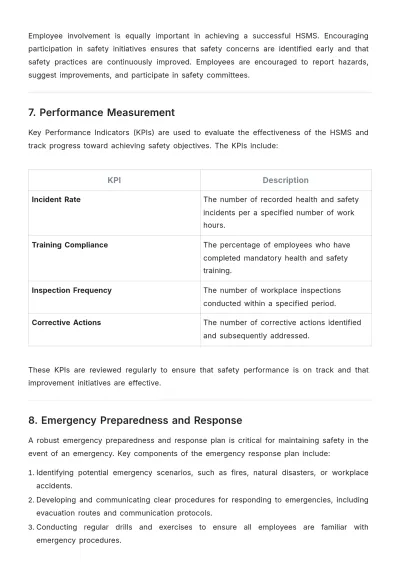
7. Performance Measurement
Key Performance Indicators (KPIs) are used to evaluate the effectiveness of the HSMS and track progress toward achieving safety objectives. The KPIs include:
KPI | Description |
|---|---|
Incident Rate | The number of recorded health and safety incidents per a specified number of work hours. |
Training Compliance | The percentage of employees who have completed mandatory health and safety training. |
Inspection Frequency | The number of workplace inspections conducted within a specified period. |
Corrective Actions | The number of corrective actions identified and subsequently addressed. |
These KPIs are reviewed regularly to ensure that safety performance is on track and that improvement initiatives are effective.
8. Emergency Preparedness and Response
A robust emergency preparedness and response plan is critical for maintaining safety in the event of an emergency. Key components of the emergency response plan include:
Identifying potential emergency scenarios, such as fires, natural disasters, or workplace accidents.
Developing and communicating clear procedures for responding to emergencies, including evacuation routes and communication protocols.
Conducting regular drills and exercises to ensure all employees are familiar with emergency procedures.
Ensuring access to emergency equipment and supplies, including fire extinguishers, first aid kits, and emergency exits.
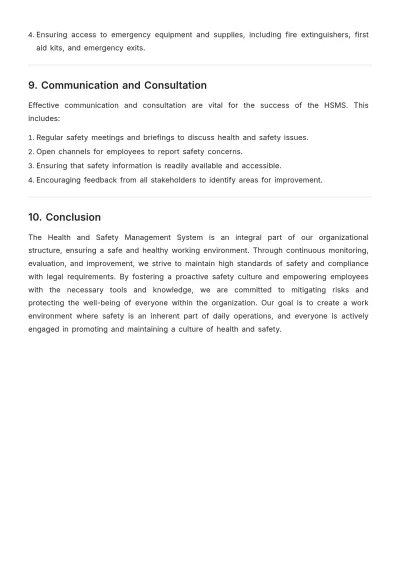
9. Communication and Consultation
Effective communication and consultation are vital for the success of the HSMS. This includes:
Regular safety meetings and briefings to discuss health and safety issues.
Open channels for employees to report safety concerns.
Ensuring that safety information is readily available and accessible.
Encouraging feedback from all stakeholders to identify areas for improvement.
10. Conclusion
The Health and Safety Management System is an integral part of our organizational structure, ensuring a safe and healthy working environment. Through continuous monitoring, evaluation, and improvement, we strive to maintain high standards of safety and compliance with legal requirements. By fostering a proactive safety culture and empowering employees with the necessary tools and knowledge, we are committed to mitigating risks and protecting the well-being of everyone within the organization. Our goal is to create a work environment where safety is an inherent part of daily operations, and everyone is actively engaged in promoting and maintaining a culture of health and safety.
- 100% Customizable, free editor
- Access 1 Million+ Templates, photo’s & graphics
- Download or share as a template
- Click and replace photos, graphics, text, backgrounds
- Resize, crop, AI write & more
- Access advanced editor
Streamline your workplace safety documentation with Template.net’s Professional Health and Safety Management System Report Template. Fully customizable and editable, this premium template ensures compliance and professionalism. Effortlessly modify it using our intuitive AI Editor Tool for tailored results. Save time and maintain top-notch standards with this essential, user-friendly solution for your health and safety needs.
You may also like
- Sales Report
- Daily Report
- Project Report
- Business Report
- Weekly Report
- Incident Report
- Annual Report
- Report Layout
- Report Design
- Progress Report
- Marketing Report
- Company Report
- Monthly Report
- Audit Report
- Status Report
- School Report
- Reports Hr
- Management Report
- Project Status Report
- Handover Report
- Health And Safety Report
- Restaurant Report
- Construction Report
- Research Report
- Evaluation Report
- Investigation Report
- Employee Report
- Advertising Report
- Weekly Status Report
- Project Management Report
- Finance Report
- Service Report
- Technical Report
- Meeting Report
- Quarterly Report
- Inspection Report
- Medical Report
- Test Report
- Summary Report
- Inventory Report
- Valuation Report
- Operations Report
- Payroll Report
- Training Report
- Job Report
- Case Report
- Performance Report
- Board Report
- Internal Audit Report
- Student Report
- Monthly Management Report
- Small Business Report
- Accident Report
- Call Center Report
- Activity Report
- IT and Software Report
- Internship Report
- Visit Report
- Product Report
- Book Report
- Property Report
- Recruitment Report
- University Report
- Event Report
- SEO Report
- Conference Report
- Narrative Report
- Nursing Home Report
- Preschool Report
- Call Report
- Customer Report
- Employee Incident Report
- Accomplishment Report
- Social Media Report
- Work From Home Report
- Security Report
- Damage Report
- Quality Report
- Internal Report
- Nurse Report
- Real Estate Report
- Hotel Report
- Equipment Report
- Credit Report
- Field Report
- Non Profit Report
- Maintenance Report
- News Report
- Survey Report
- Executive Report
- Law Firm Report
- Advertising Agency Report
- Interior Design Report
- Travel Agency Report
- Stock Report
- Salon Report
- Bug Report
- Workplace Report
- Action Report
- Investor Report
- Cleaning Services Report
- Consulting Report
- Freelancer Report
- Site Visit Report
- Trip Report
- Classroom Observation Report
- Vehicle Report
- Final Report
- Software Report