Free Gym Financial Plan

Introduction
The Gym Financial Plan for [Your Company Name] is designed to provide a clear and detailed roadmap for managing the financial health and sustainability of the gym. This plan outlines the strategies and actions required to optimize revenue, control expenses, and ensure long-term profitability. By focusing on key financial areas such as revenue streams, cost management, capital expenditures, and financial forecasting, this plan aims to enhance the gym’s financial stability and support its growth objectives.
1. Revenue Streams
Revenue streams are the various sources of income that contribute to the gym’s overall revenue. By diversifying revenue streams, [Your Company Name] can increase its financial resilience and reduce dependency on any single source of income. This section outlines the primary revenue streams and provides strategies for maximizing income from each.
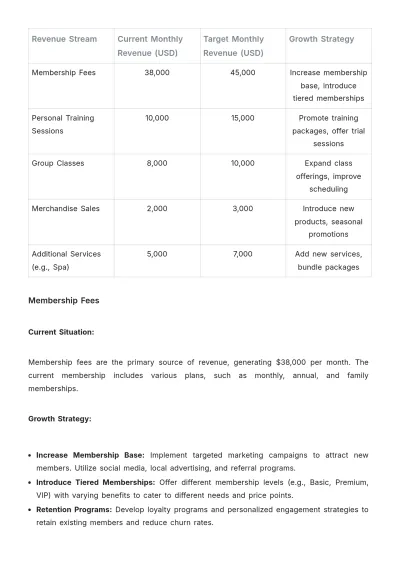
Revenue Streams Table
Revenue Stream | Current Monthly Revenue (USD) | Target Monthly Revenue (USD) | Growth Strategy |
|---|---|---|---|
Membership Fees | 38,000 | 45,000 | Increase membership base, introduce tiered memberships |
Personal Training Sessions | 10,000 | 15,000 | Promote training packages, offer trial sessions |
Group Classes | 8,000 | 10,000 | Expand class offerings, improve scheduling |
Merchandise Sales | 2,000 | 3,000 | Introduce new products, seasonal promotions |
Additional Services (e.g., Spa) | 5,000 | 7,000 | Add new services, bundle packages |
Membership Fees
Current Situation:
Membership fees are the primary source of revenue, generating $38,000 per month. The current membership includes various plans, such as monthly, annual, and family memberships.
Growth Strategy:
Increase Membership Base: Implement targeted marketing campaigns to attract new members. Utilize social media, local advertising, and referral programs.
Introduce Tiered Memberships: Offer different membership levels (e.g., Basic, Premium, VIP) with varying benefits to cater to different needs and price points.
Retention Programs: Develop loyalty programs and personalized engagement strategies to retain existing members and reduce churn rates.
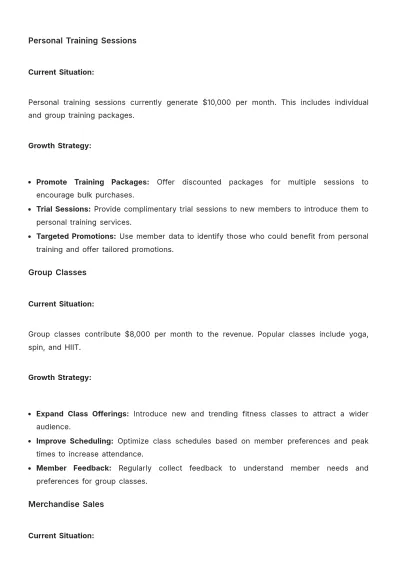
Personal Training Sessions
Current Situation:
Personal training sessions currently generate $10,000 per month. This includes individual and group training packages.
Growth Strategy:
Promote Training Packages: Offer discounted packages for multiple sessions to encourage bulk purchases.
Trial Sessions: Provide complimentary trial sessions to new members to introduce them to personal training services.
Targeted Promotions: Use member data to identify those who could benefit from personal training and offer tailored promotions.
Group Classes
Current Situation:
Group classes contribute $8,000 per month to the revenue. Popular classes include yoga, spin, and HIIT.
Growth Strategy:
Expand Class Offerings: Introduce new and trending fitness classes to attract a wider audience.
Improve Scheduling: Optimize class schedules based on member preferences and peak times to increase attendance.
Member Feedback: Regularly collect feedback to understand member needs and preferences for group classes.
Merchandise Sales
Current Situation:
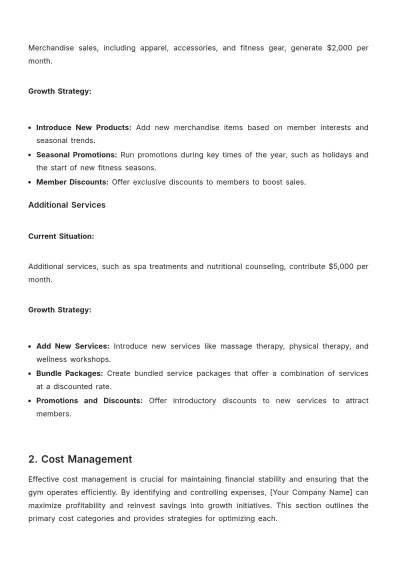
Merchandise sales, including apparel, accessories, and fitness gear, generate $2,000 per month.
Growth Strategy:
Introduce New Products: Add new merchandise items based on member interests and seasonal trends.
Seasonal Promotions: Run promotions during key times of the year, such as holidays and the start of new fitness seasons.
Member Discounts: Offer exclusive discounts to members to boost sales.
Additional Services
Current Situation:
Additional services, such as spa treatments and nutritional counseling, contribute $5,000 per month.
Growth Strategy:
Add New Services: Introduce new services like massage therapy, physical therapy, and wellness workshops.
Bundle Packages: Create bundled service packages that offer a combination of services at a discounted rate.
Promotions and Discounts: Offer introductory discounts to new services to attract members.
2. Cost Management
Effective cost management is crucial for maintaining financial stability and ensuring that the gym operates efficiently. By identifying and controlling expenses, [Your Company Name] can maximize profitability and reinvest savings into growth initiatives. This section outlines the primary cost categories and provides strategies for optimizing each.
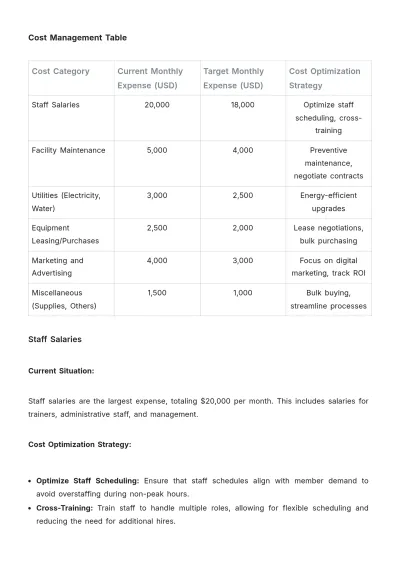
Cost Management Table
Cost Category | Current Monthly Expense (USD) | Target Monthly Expense (USD) | Cost Optimization Strategy |
|---|---|---|---|
Staff Salaries | 20,000 | 18,000 | Optimize staff scheduling, cross-training |
Facility Maintenance | 5,000 | 4,000 | Preventive maintenance, negotiate contracts |
Utilities (Electricity, Water) | 3,000 | 2,500 | Energy-efficient upgrades |
Equipment Leasing/Purchases | 2,500 | 2,000 | Lease negotiations, bulk purchasing |
Marketing and Advertising | 4,000 | 3,000 | Focus on digital marketing, track ROI |
Miscellaneous (Supplies, Others) | 1,500 | 1,000 | Bulk buying, streamline processes |
Staff Salaries
Current Situation:
Staff salaries are the largest expense, totaling $20,000 per month. This includes salaries for trainers, administrative staff, and management.
Cost Optimization Strategy:
Optimize Staff Scheduling: Ensure that staff schedules align with member demand to avoid overstaffing during non-peak hours.
Cross-Training: Train staff to handle multiple roles, allowing for flexible scheduling and reducing the need for additional hires.
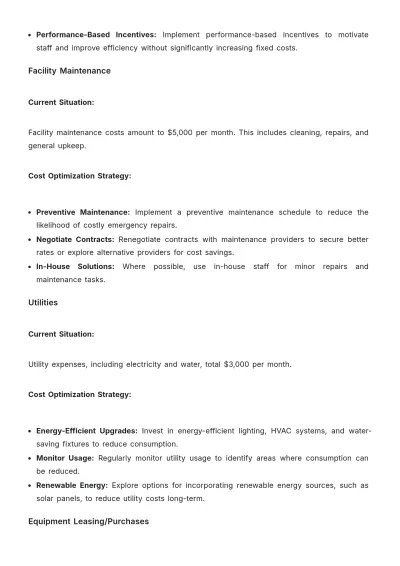
Performance-Based Incentives: Implement performance-based incentives to motivate staff and improve efficiency without significantly increasing fixed costs.
Facility Maintenance
Current Situation:
Facility maintenance costs amount to $5,000 per month. This includes cleaning, repairs, and general upkeep.
Cost Optimization Strategy:
Preventive Maintenance: Implement a preventive maintenance schedule to reduce the likelihood of costly emergency repairs.
Negotiate Contracts: Renegotiate contracts with maintenance providers to secure better rates or explore alternative providers for cost savings.
In-House Solutions: Where possible, use in-house staff for minor repairs and maintenance tasks.
Utilities
Current Situation:
Utility expenses, including electricity and water, total $3,000 per month.
Cost Optimization Strategy:
Energy-Efficient Upgrades: Invest in energy-efficient lighting, HVAC systems, and water-saving fixtures to reduce consumption.
Monitor Usage: Regularly monitor utility usage to identify areas where consumption can be reduced.
Renewable Energy: Explore options for incorporating renewable energy sources, such as solar panels, to reduce utility costs long-term.
Equipment Leasing/Purchases
Current Situation:
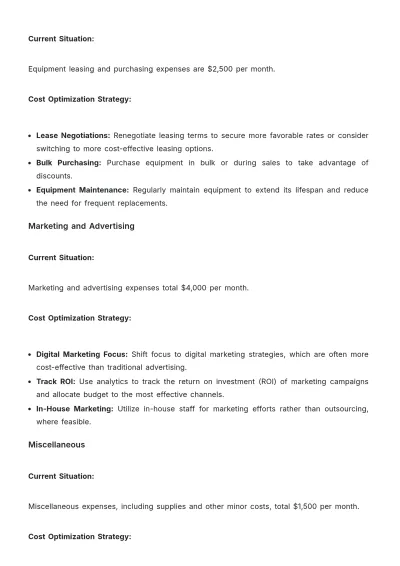
Equipment leasing and purchasing expenses are $2,500 per month.
Cost Optimization Strategy:
Lease Negotiations: Renegotiate leasing terms to secure more favorable rates or consider switching to more cost-effective leasing options.
Bulk Purchasing: Purchase equipment in bulk or during sales to take advantage of discounts.
Equipment Maintenance: Regularly maintain equipment to extend its lifespan and reduce the need for frequent replacements.
Marketing and Advertising
Current Situation:
Marketing and advertising expenses total $4,000 per month.
Cost Optimization Strategy:
Digital Marketing Focus: Shift focus to digital marketing strategies, which are often more cost-effective than traditional advertising.
Track ROI: Use analytics to track the return on investment (ROI) of marketing campaigns and allocate budget to the most effective channels.
In-House Marketing: Utilize in-house staff for marketing efforts rather than outsourcing, where feasible.
Miscellaneous
Current Situation:
Miscellaneous expenses, including supplies and other minor costs, total $1,500 per month.
Cost Optimization Strategy:
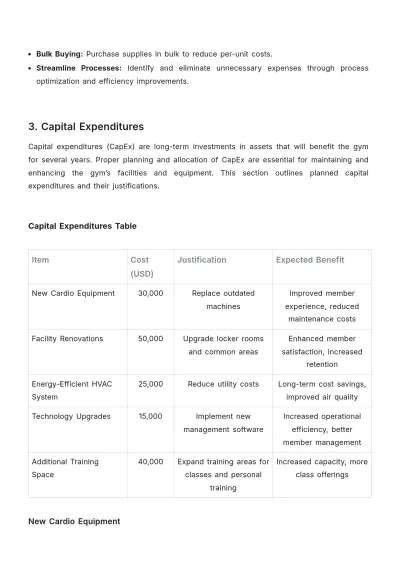
Bulk Buying: Purchase supplies in bulk to reduce per-unit costs.
Streamline Processes: Identify and eliminate unnecessary expenses through process optimization and efficiency improvements.
3. Capital Expenditures
Capital expenditures (CapEx) are long-term investments in assets that will benefit the gym for several years. Proper planning and allocation of CapEx are essential for maintaining and enhancing the gym’s facilities and equipment. This section outlines planned capital expenditures and their justifications.
Capital Expenditures Table
Item | Cost (USD) | Justification | Expected Benefit |
|---|---|---|---|
New Cardio Equipment | 30,000 | Replace outdated machines | Improved member experience, reduced maintenance costs |
Facility Renovations | 50,000 | Upgrade locker rooms and common areas | Enhanced member satisfaction, increased retention |
Energy-Efficient HVAC System | 25,000 | Reduce utility costs | Long-term cost savings, improved air quality |
Technology Upgrades | 15,000 | Implement new management software | Increased operational efficiency, better member management |
Additional Training Space | 40,000 | Expand training areas for classes and personal training | Increased capacity, more class offerings |
New Cardio Equipment
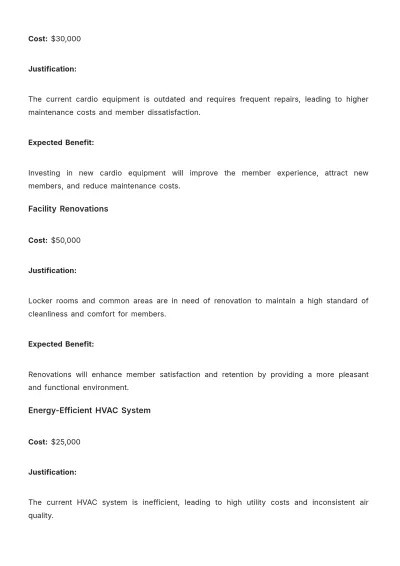
Cost: $30,000
Justification:
The current cardio equipment is outdated and requires frequent repairs, leading to higher maintenance costs and member dissatisfaction.
Expected Benefit:
Investing in new cardio equipment will improve the member experience, attract new members, and reduce maintenance costs.
Facility Renovations
Cost: $50,000
Justification:
Locker rooms and common areas are in need of renovation to maintain a high standard of cleanliness and comfort for members.
Expected Benefit:
Renovations will enhance member satisfaction and retention by providing a more pleasant and functional environment.
Energy-Efficient HVAC System
Cost: $25,000
Justification:
The current HVAC system is inefficient, leading to high utility costs and inconsistent air quality.
Expected Benefit:
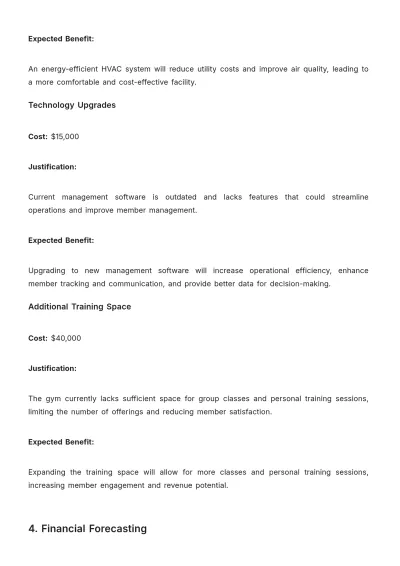
An energy-efficient HVAC system will reduce utility costs and improve air quality, leading to a more comfortable and cost-effective facility.
Technology Upgrades
Cost: $15,000
Justification:
Current management software is outdated and lacks features that could streamline operations and improve member management.
Expected Benefit:
Upgrading to new management software will increase operational efficiency, enhance member tracking and communication, and provide better data for decision-making.
Additional Training Space
Cost: $40,000
Justification:
The gym currently lacks sufficient space for group classes and personal training sessions, limiting the number of offerings and reducing member satisfaction.
Expected Benefit:
Expanding the training space will allow for more classes and personal training sessions, increasing member engagement and revenue potential.
4. Financial Forecasting
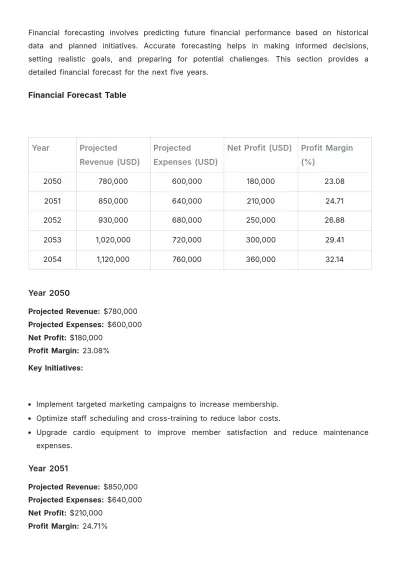
Financial forecasting involves predicting future financial performance based on historical data and planned initiatives. Accurate forecasting helps in making informed decisions, setting realistic goals, and preparing for potential challenges. This section provides a detailed financial forecast for the next five years.
Financial Forecast Table
Year | Projected Revenue (USD) | Projected Expenses (USD) | Net Profit (USD) | Profit Margin (%) |
|---|---|---|---|---|
2050 | 780,000 | 600,000 | 180,000 | 23.08 |
2051 | 850,000 | 640,000 | 210,000 | 24.71 |
2052 | 930,000 | 680,000 | 250,000 | 26.88 |
2053 | 1,020,000 | 720,000 | 300,000 | 29.41 |
2054 | 1,120,000 | 760,000 | 360,000 | 32.14 |
Year 2050
Projected Revenue: $780,000
Projected Expenses: $600,000
Net Profit: $180,000
Profit Margin: 23.08%
Key Initiatives:
Implement targeted marketing campaigns to increase membership.
Optimize staff scheduling and cross-training to reduce labor costs.
Upgrade cardio equipment to improve member satisfaction and reduce maintenance expenses.
Year 2051
Projected Revenue: $850,000
Projected Expenses: $640,000
Net Profit: $210,000
Profit Margin: 24.71%
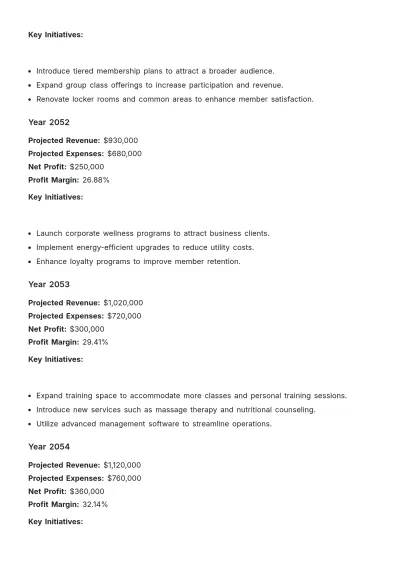
Key Initiatives:
Introduce tiered membership plans to attract a broader audience.
Expand group class offerings to increase participation and revenue.
Renovate locker rooms and common areas to enhance member satisfaction.
Year 2052
Projected Revenue: $930,000
Projected Expenses: $680,000
Net Profit: $250,000
Profit Margin: 26.88%
Key Initiatives:
Launch corporate wellness programs to attract business clients.
Implement energy-efficient upgrades to reduce utility costs.
Enhance loyalty programs to improve member retention.
Year 2053
Projected Revenue: $1,020,000
Projected Expenses: $720,000
Net Profit: $300,000
Profit Margin: 29.41%
Key Initiatives:
Expand training space to accommodate more classes and personal training sessions.
Introduce new services such as massage therapy and nutritional counseling.
Utilize advanced management software to streamline operations.
Year 2054
Projected Revenue: $1,120,000
Projected Expenses: $760,000
Net Profit: $360,000
Profit Margin: 32.14%
Key Initiatives:
Continue to innovate and introduce new fitness programs.
Strengthen community partnerships to enhance brand visibility.
Focus on continuous improvement and member satisfaction.
5. Risk Management
Risk management involves identifying, assessing, and mitigating potential risks that could impact the gym's financial stability and operations. By proactively managing risks, [Your Company Name] can minimize negative impacts and ensure long-term success. This section outlines key risks and mitigation strategies.
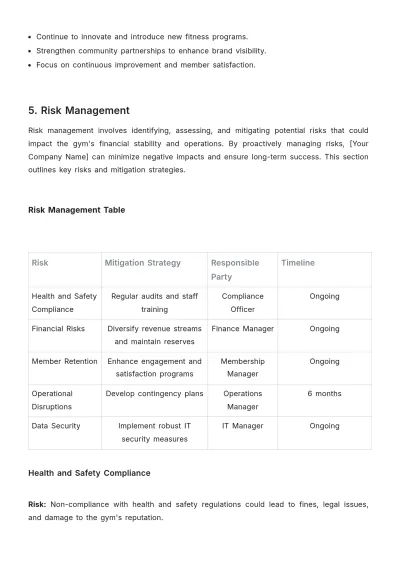
Risk Management Table
Risk | Mitigation Strategy | Responsible Party | Timeline |
|---|---|---|---|
Health and Safety Compliance | Regular audits and staff training | Compliance Officer | Ongoing |
Financial Risks | Diversify revenue streams and maintain reserves | Finance Manager | Ongoing |
Member Retention | Enhance engagement and satisfaction programs | Membership Manager | Ongoing |
Operational Disruptions | Develop contingency plans | Operations Manager | 6 months |
Data Security | Implement robust IT security measures | IT Manager | Ongoing |
Health and Safety Compliance
Risk: Non-compliance with health and safety regulations could lead to fines, legal issues, and damage to the gym's reputation.
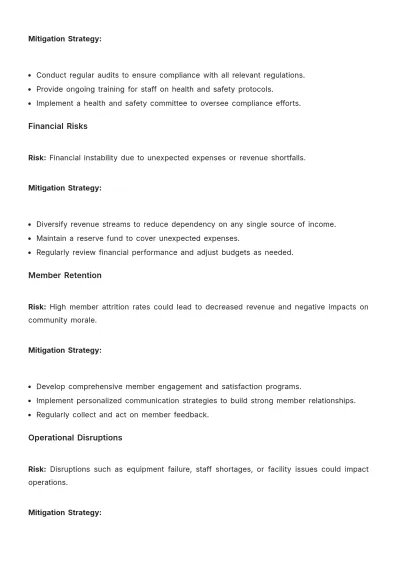
Mitigation Strategy:
Conduct regular audits to ensure compliance with all relevant regulations.
Provide ongoing training for staff on health and safety protocols.
Implement a health and safety committee to oversee compliance efforts.
Financial Risks
Risk: Financial instability due to unexpected expenses or revenue shortfalls.
Mitigation Strategy:
Diversify revenue streams to reduce dependency on any single source of income.
Maintain a reserve fund to cover unexpected expenses.
Regularly review financial performance and adjust budgets as needed.
Member Retention
Risk: High member attrition rates could lead to decreased revenue and negative impacts on community morale.
Mitigation Strategy:
Develop comprehensive member engagement and satisfaction programs.
Implement personalized communication strategies to build strong member relationships.
Regularly collect and act on member feedback.
Operational Disruptions
Risk: Disruptions such as equipment failure, staff shortages, or facility issues could impact operations.
Mitigation Strategy:
Develop contingency plans for various types of disruptions.
Maintain a well-trained and flexible staff to cover for absences or increased demand.
Regularly maintain and upgrade facilities and equipment to prevent failures.
Data Security
Risk: Data breaches or IT system failures could compromise member information and disrupt operations.
Mitigation Strategy:
Implement robust IT security measures, including encryption and regular security audits.
Train staff on data security best practices.
Maintain regular backups of all critical data and systems.
Conclusion
This comprehensive Gym Financial Plan outlines the strategies and actions required to ensure the financial stability and growth of [Your Company Name]. By focusing on diversified revenue streams, effective cost management, strategic capital expenditures, accurate financial forecasting, and proactive risk management, the gym can achieve its long-term financial objectives. Regular monitoring and adjustment of this plan will ensure that the gym remains adaptive and responsive to changing market conditions and member needs.
Prepared by:
[Your Name]
[Your Title]
[Your Company Name]
[Your Company Number]
[Your Email]
[Your Company Website]
- 100% Customizable, free editor
- Access 1 Million+ Templates, photo’s & graphics
- Download or share as a template
- Click and replace photos, graphics, text, backgrounds
- Resize, crop, AI write & more
- Access advanced editor
Streamline your gym's financial strategy with the Gym Financial Plan Template from Template.net. Designed for gym owners and financial managers, this editable and customizable template, facilitated by our AI editor tool, helps you meticulously outline your budget, forecast revenue, and plan for expenses. Ideal for securing the financial health and sustainability of your fitness center.
You may also like
- Finance Plan
- Construction Plan
- Sales Plan
- Development Plan
- Career Plan
- Budget Plan
- HR Plan
- Education Plan
- Transition Plan
- Work Plan
- Training Plan
- Communication Plan
- Operation Plan
- Health And Safety Plan
- Strategy Plan
- Professional Development Plan
- Advertising Plan
- Risk Management Plan
- Restaurant Plan
- School Plan
- Nursing Home Patient Care Plan
- Nursing Care Plan
- Plan Event
- Startup Plan
- Social Media Plan
- Staffing Plan
- Annual Plan
- Content Plan
- Payment Plan
- Implementation Plan
- Hotel Plan
- Workout Plan
- Accounting Plan
- Campaign Plan
- Essay Plan
- 30 60 90 Day Plan
- Research Plan
- Recruitment Plan
- 90 Day Plan
- Quarterly Plan
- Emergency Plan
- 5 Year Plan
- Gym Plan
- Personal Plan
- IT and Software Plan
- Treatment Plan
- Real Estate Plan
- Law Firm Plan
- Healthcare Plan
- Improvement Plan
- Media Plan
- 5 Year Business Plan
- Learning Plan
- Marketing Campaign Plan
- Travel Agency Plan
- Cleaning Services Plan
- Interior Design Plan
- Performance Plan
- PR Plan
- Birth Plan
- Life Plan
- SEO Plan
- Disaster Recovery Plan
- Continuity Plan
- Launch Plan
- Legal Plan
- Behavior Plan
- Performance Improvement Plan
- Salon Plan
- Security Plan
- Security Management Plan
- Employee Development Plan
- Quality Plan
- Service Improvement Plan
- Growth Plan
- Incident Response Plan
- Basketball Plan
- Emergency Action Plan
- Product Launch Plan
- Spa Plan
- Employee Training Plan
- Data Analysis Plan
- Employee Action Plan
- Territory Plan
- Audit Plan
- Classroom Plan
- Activity Plan
- Parenting Plan
- Care Plan
- Project Execution Plan
- Exercise Plan
- Internship Plan
- Software Development Plan
- Continuous Improvement Plan
- Leave Plan
- 90 Day Sales Plan
- Advertising Agency Plan
- Employee Transition Plan
- Smart Action Plan
- Workplace Safety Plan
- Behavior Change Plan
- Contingency Plan
- Continuity of Operations Plan
- Health Plan
- Quality Control Plan
- Self Plan
- Sports Development Plan
- Change Management Plan
- Ecommerce Plan
- Personal Financial Plan
- Process Improvement Plan
- 30-60-90 Day Sales Plan
- Crisis Management Plan
- Engagement Plan
- Execution Plan
- Pandemic Plan
- Quality Assurance Plan
- Service Continuity Plan
- Agile Project Plan
- Fundraising Plan
- Job Transition Plan
- Asset Maintenance Plan
- Maintenance Plan
- Software Test Plan
- Staff Training and Development Plan
- 3 Year Plan
- Brand Activation Plan
- Release Plan
- Resource Plan
- Risk Mitigation Plan
- Teacher Plan
- 30 60 90 Day Plan for New Manager
- Food Safety Plan
- Food Truck Plan
- Hiring Plan
- Quality Management Plan
- Wellness Plan
- Behavior Intervention Plan
- Bonus Plan
- Investment Plan
- Maternity Leave Plan
- Pandemic Response Plan
- Succession Planning
- Coaching Plan
- Configuration Management Plan
- Remote Work Plan
- Self Care Plan
- Teaching Plan
- 100-Day Plan
- HACCP Plan
- Student Plan
- Sustainability Plan
- 30 60 90 Day Plan for Interview
- Access Plan
- Site Specific Safety Plan