Free Unit Plan

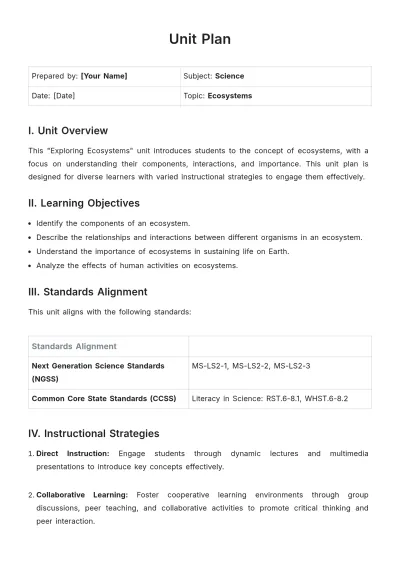
Prepared by: [Your Name] | Subject: Science |
Date: [Date] | Topic: Ecosystems |
I. Unit Overview
This "Exploring Ecosystems" unit introduces students to the concept of ecosystems, with a focus on understanding their components, interactions, and importance. This unit plan is designed for diverse learners with varied instructional strategies to engage them effectively.
II. Learning Objectives
Identify the components of an ecosystem.
Describe the relationships and interactions between different organisms in an ecosystem.
Understand the importance of ecosystems in sustaining life on Earth.
Analyze the effects of human activities on ecosystems.
III. Standards Alignment
This unit aligns with the following standards:
Standards Alignment | |
|---|---|
Next Generation Science Standards (NGSS) | MS-LS2-1, MS-LS2-2, MS-LS2-3 |
Common Core State Standards (CCSS) | Literacy in Science: RST.6-8.1, WHST.6-8.2 |
IV. Instructional Strategies
Direct Instruction: Engage students through dynamic lectures and multimedia presentations to introduce key concepts effectively.
Collaborative Learning: Foster cooperative learning environments through group discussions, peer teaching, and collaborative activities to promote critical thinking and peer interaction.
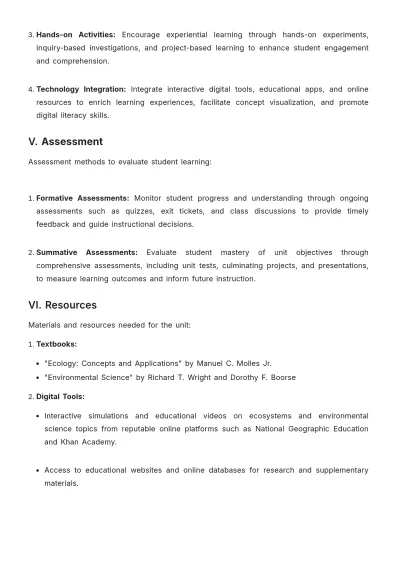
Hands-on Activities: Encourage experiential learning through hands-on experiments, inquiry-based investigations, and project-based learning to enhance student engagement and comprehension.
Technology Integration: Integrate interactive digital tools, educational apps, and online resources to enrich learning experiences, facilitate concept visualization, and promote digital literacy skills.
V. Assessment
Assessment methods to evaluate student learning:
Formative Assessments: Monitor student progress and understanding through ongoing assessments such as quizzes, exit tickets, and class discussions to provide timely feedback and guide instructional decisions.
Summative Assessments: Evaluate student mastery of unit objectives through comprehensive assessments, including unit tests, culminating projects, and presentations, to measure learning outcomes and inform future instruction.
VI. Resources
Materials and resources needed for the unit:
Textbooks:
"Ecology: Concepts and Applications" by Manuel C. Molles Jr.
"Environmental Science" by Richard T. Wright and Dorothy F. Boorse
Digital Tools:
Interactive simulations and educational videos on ecosystems and environmental science topics from reputable online platforms such as National Geographic Education and Khan Academy.
Access to educational websites and online databases for research and supplementary materials.
Lab Materials:
Observation kits including magnifying glasses, binoculars, and field guides for outdoor explorations.
Plant samples, soil testing kits, and other laboratory equipment for hands-on experiments and investigations.
Microscopes, slides, and specimen jars for observing microscopic organisms and ecological samples.
Reference Websites:
[Your Company Website]: Access additional resources, lesson plans, and professional development opportunities tailored to support educators in teaching ecosystem concepts effectively.
National Geographic's "Ecosystems" interactive website: Explore virtual ecosystems, interactive maps, and multimedia resources to enhance student understanding of ecosystem dynamics and biodiversity.
VII. Lesson Plan Schedule
Lesson | Topic | Activities | Assessment |
|---|---|---|---|
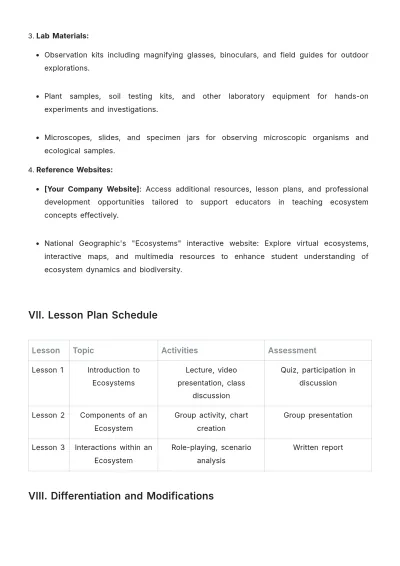
Lesson 1 | Introduction to Ecosystems | Lecture, video presentation, class discussion | Quiz, participation in discussion |
Lesson 2 | Components of an Ecosystem | Group activity, chart creation | Group presentation |
Lesson 3 | Interactions within an Ecosystem | Role-playing, scenario analysis | Written report |
VIII. Differentiation and Modifications
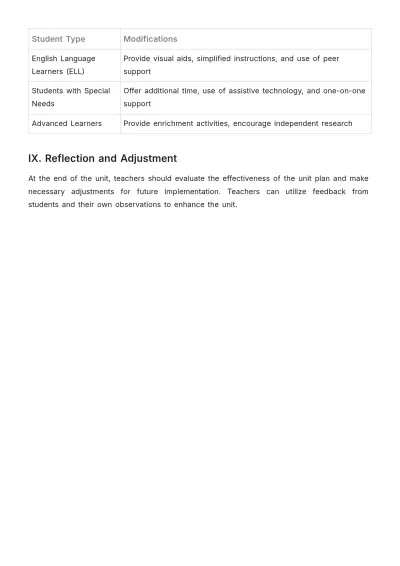
Student Type | Modifications |
|---|---|
English Language Learners (ELL) | Provide visual aids, simplified instructions, and use of peer support |
Students with Special Needs | Offer additional time, use of assistive technology, and one-on-one support |
Advanced Learners | Provide enrichment activities, encourage independent research |
IX. Reflection and Adjustment
At the end of the unit, teachers should evaluate the effectiveness of the unit plan and make necessary adjustments for future implementation. Teachers can utilize feedback from students and their own observations to enhance the unit.
- 100% Customizable, free editor
- Access 1 Million+ Templates, photo’s & graphics
- Download or share as a template
- Click and replace photos, graphics, text, backgrounds
- Resize, crop, AI write & more
- Access advanced editor
Streamline your lesson planning with the Unit Plan Template offered by Template.net. This customizable and downloadable template ensures you have a well-structured and efficient teaching plan. Printable for easy access, it’s also fully editable in our AI Editor Tool, allowing you to tailor every detail to meet your specific needs. Elevate your classroom preparation effortlessly with this versatile resource.
You may also like
- Finance Plan
- Construction Plan
- Sales Plan
- Development Plan
- Career Plan
- Budget Plan
- HR Plan
- Education Plan
- Transition Plan
- Work Plan
- Training Plan
- Communication Plan
- Operation Plan
- Health And Safety Plan
- Strategy Plan
- Professional Development Plan
- Advertising Plan
- Risk Management Plan
- Restaurant Plan
- School Plan
- Nursing Home Patient Care Plan
- Nursing Care Plan
- Plan Event
- Startup Plan
- Social Media Plan
- Staffing Plan
- Annual Plan
- Content Plan
- Payment Plan
- Implementation Plan
- Hotel Plan
- Workout Plan
- Accounting Plan
- Campaign Plan
- Essay Plan
- 30 60 90 Day Plan
- Research Plan
- Recruitment Plan
- 90 Day Plan
- Quarterly Plan
- Emergency Plan
- 5 Year Plan
- Gym Plan
- Personal Plan
- IT and Software Plan
- Treatment Plan
- Real Estate Plan
- Law Firm Plan
- Healthcare Plan
- Improvement Plan
- Media Plan
- 5 Year Business Plan
- Learning Plan
- Marketing Campaign Plan
- Travel Agency Plan
- Cleaning Services Plan
- Interior Design Plan
- Performance Plan
- PR Plan
- Birth Plan
- Life Plan
- SEO Plan
- Disaster Recovery Plan
- Continuity Plan
- Launch Plan
- Legal Plan
- Behavior Plan
- Performance Improvement Plan
- Salon Plan
- Security Plan
- Security Management Plan
- Employee Development Plan
- Quality Plan
- Service Improvement Plan
- Growth Plan
- Incident Response Plan
- Basketball Plan
- Emergency Action Plan
- Product Launch Plan
- Spa Plan
- Employee Training Plan
- Data Analysis Plan
- Employee Action Plan
- Territory Plan
- Audit Plan
- Classroom Plan
- Activity Plan
- Parenting Plan
- Care Plan
- Project Execution Plan
- Exercise Plan
- Internship Plan
- Software Development Plan
- Continuous Improvement Plan
- Leave Plan
- 90 Day Sales Plan
- Advertising Agency Plan
- Employee Transition Plan
- Smart Action Plan
- Workplace Safety Plan
- Behavior Change Plan
- Contingency Plan
- Continuity of Operations Plan
- Health Plan
- Quality Control Plan
- Self Plan
- Sports Development Plan
- Change Management Plan
- Ecommerce Plan
- Personal Financial Plan
- Process Improvement Plan
- 30-60-90 Day Sales Plan
- Crisis Management Plan
- Engagement Plan
- Execution Plan
- Pandemic Plan
- Quality Assurance Plan
- Service Continuity Plan
- Agile Project Plan
- Fundraising Plan
- Job Transition Plan
- Asset Maintenance Plan
- Maintenance Plan
- Software Test Plan
- Staff Training and Development Plan
- 3 Year Plan
- Brand Activation Plan
- Release Plan
- Resource Plan
- Risk Mitigation Plan
- Teacher Plan
- 30 60 90 Day Plan for New Manager
- Food Safety Plan
- Food Truck Plan
- Hiring Plan
- Quality Management Plan
- Wellness Plan
- Behavior Intervention Plan
- Bonus Plan
- Investment Plan
- Maternity Leave Plan
- Pandemic Response Plan
- Succession Planning
- Coaching Plan
- Configuration Management Plan
- Remote Work Plan
- Self Care Plan
- Teaching Plan
- 100-Day Plan
- HACCP Plan
- Student Plan
- Sustainability Plan
- 30 60 90 Day Plan for Interview
- Access Plan
- Site Specific Safety Plan