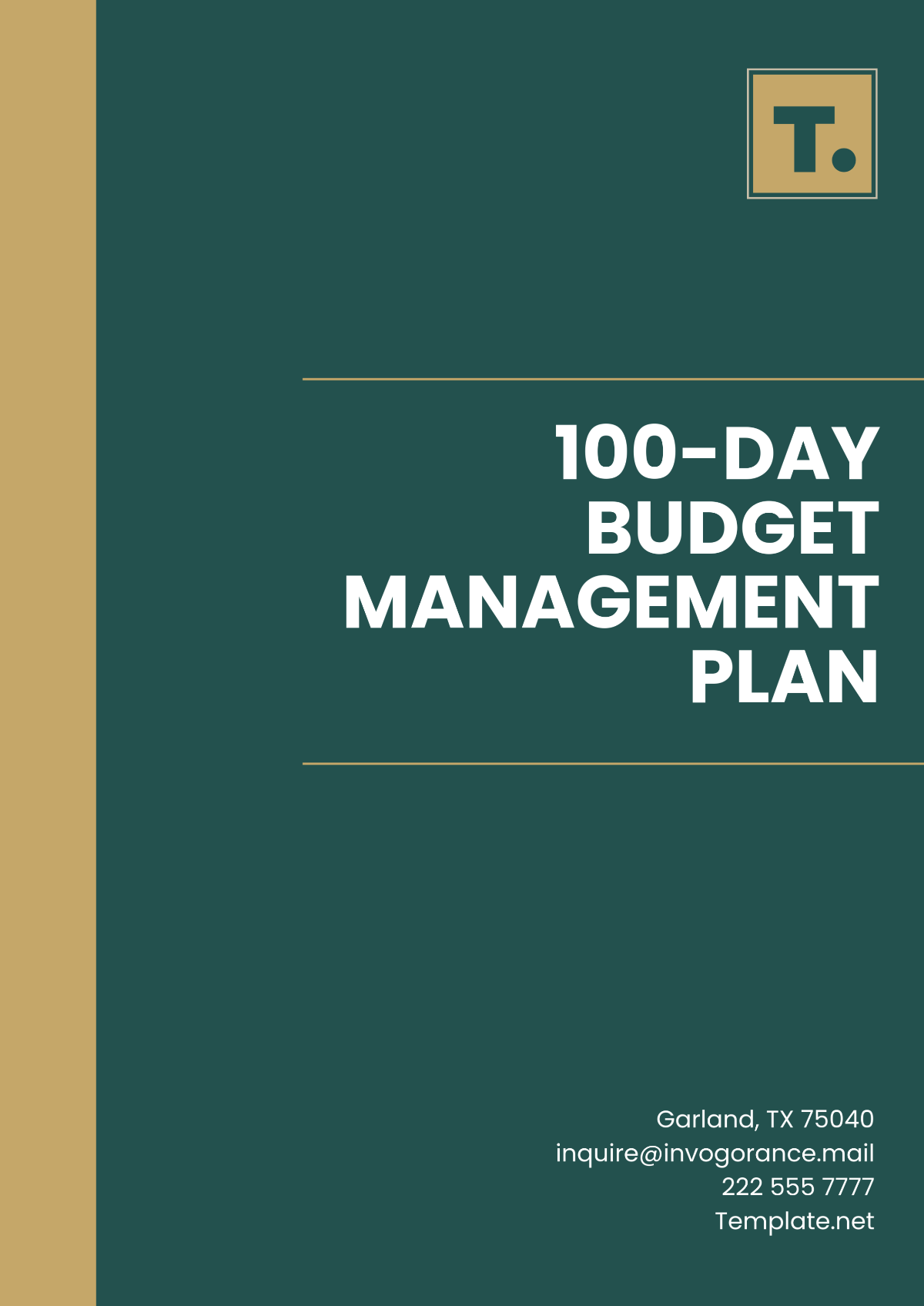
Free 100-Day Budget Management Plan

Prepared by:
[Your Name]
[Your Company Name]
Objective
This 100-day Budget Management Plan is designed to ensure effective financial planning, resource allocation, and cost control during the initial 100 days of a new project, leadership transition, or organizational change. The plan outlines key financial goals, budget allocation, tracking mechanisms, and strategies for maintaining financial stability.
I. Introduction
The 100-Day Budget Management Plan serves as a strategic tool to guide financial operations and resource management within the first three months of a significant change or project. It aims to provide clear financial objectives, control spending, and ensure that the organization remains financially stable and aligned with broader goals during this critical period.
II. Key Financial Objectives
Establish Financial Stability: Ensure all financial operations are aligned with the organization’s overall goals and objectives.
Allocate Resources Effectively: Prioritize spending on critical areas to support growth, project initiation, or leadership transition.
Control Costs: Monitor and limit unnecessary expenditures to keep costs within budgeted limits.
Track Financial Performance: Implement robust tracking mechanisms to assess financial performance against targets.
Build Financial Forecasts: Develop and review updated financial forecasts based on real-time data.
III. Budget Allocation Overview
3.1 Initial Budget Breakdown
Category | Percentage of Budget |
|---|---|
Personnel Costs | 35% |
Operational Expenses | 25% |
Marketing/Advertising | 15% |
Contingency Fund | 10% |
Technology/Software Investments | 10% |
Miscellaneous/Unforeseen Costs | 5% |
3.2 Key Focus Areas for Allocation
Human Resources: Hiring key personnel, staff training, and onboarding costs.
Infrastructure & Equipment: Ensuring necessary resources and technology are in place to support new operations.
Marketing & Communication: Campaigns, promotional materials, and external communications to build awareness.
Project Costs: Ensuring that project milestones are met within the defined budget.
IV. Timeline & Milestones
Phase 1: Days 1-30 (Establishing Foundation)
Budget Setup & Allocation: Review and finalize the initial budget breakdown.
Assess Initial Costs: Monitor spending on essential operations.
Establish Financial Tracking Tools: Implement accounting software, and budget tracking systems, and set up reporting processes.
Phase 2: Days 31-60 (Operational Adjustment)
Review Budget Allocation: Ensure resource allocation aligns with priorities.
Financial Performance Review: Evaluate expenditures against initial forecasts.
Adjustments to Spending: Reallocate funds to critical areas if necessary.
Phase 3: Days 61-100 (Optimizing Performance)
Refine Financial Forecasts: Use insights gained from tracking to refine budget forecasts for future periods.
Cost Control Measures: Implement cost-saving initiatives without compromising project quality.
Final Performance Review: Evaluate overall financial health and prepare a summary report.
V. Tracking and Reporting Mechanisms
5.1 Weekly Budget Reviews
Conduct a weekly review of the budget to track spending and make adjustments where necessary.
5.2 Monthly Financial Report
At the end of each month, prepare a detailed financial report showing expenses, forecasts, and deviations from the plan.
5.3 Key Performance Indicators (KPIs)
Cost Variance: Comparison of actual spending versus budgeted amount.
Project Progress: Evaluate how the budget impacts project completion and milestones.
Cash Flow: Monitoring the inflow and outflow of funds to ensure liquidity.
VI. Risk Management & Contingency Planning
Contingency Fund: Set aside 10% of the overall budget to address unforeseen circumstances or changes.
Cost Escalation Control: Ensure that spending on projects does not exceed planned amounts without prior review and justification.
Alternative Funding: Identify potential sources of funding if additional resources are required.
VII. Conclusion
By implementing this 100-day Budget Management Plan, the organization can ensure effective financial oversight, track expenditures against forecasts, and adjust allocations based on real-time needs. This structured approach provides a strong foundation for successful project completion, leadership transition, or organizational change while maintaining financial stability.
- 100% Customizable, free editor
- Access 1 Million+ Templates, photo’s & graphics
- Download or share as a template
- Click and replace photos, graphics, text, backgrounds
- Resize, crop, AI write & more
- Access advanced editor
The 100-Day Budget Management Plan Template from Template.net is an editable and customizable tool designed to help you manage finances effectively. Fully editable in our Ai Editor Tool, this template allows you to personalize your budget, track expenses, and set financial goals, ensuring a structured and efficient approach to managing your budget over 100 days.
You may also like
- Finance Plan
- Construction Plan
- Sales Plan
- Development Plan
- Career Plan
- Budget Plan
- HR Plan
- Education Plan
- Transition Plan
- Work Plan
- Training Plan
- Communication Plan
- Operation Plan
- Health And Safety Plan
- Strategy Plan
- Professional Development Plan
- Advertising Plan
- Risk Management Plan
- Restaurant Plan
- School Plan
- Nursing Home Patient Care Plan
- Nursing Care Plan
- Plan Event
- Startup Plan
- Social Media Plan
- Staffing Plan
- Annual Plan
- Content Plan
- Payment Plan
- Implementation Plan
- Hotel Plan
- Workout Plan
- Accounting Plan
- Campaign Plan
- Essay Plan
- 30 60 90 Day Plan
- Research Plan
- Recruitment Plan
- 90 Day Plan
- Quarterly Plan
- Emergency Plan
- 5 Year Plan
- Gym Plan
- Personal Plan
- IT and Software Plan
- Treatment Plan
- Real Estate Plan
- Law Firm Plan
- Healthcare Plan
- Improvement Plan
- Media Plan
- 5 Year Business Plan
- Learning Plan
- Marketing Campaign Plan
- Travel Agency Plan
- Cleaning Services Plan
- Interior Design Plan
- Performance Plan
- PR Plan
- Birth Plan
- Life Plan
- SEO Plan
- Disaster Recovery Plan
- Continuity Plan
- Launch Plan
- Legal Plan
- Behavior Plan
- Performance Improvement Plan
- Salon Plan
- Security Plan
- Security Management Plan
- Employee Development Plan
- Quality Plan
- Service Improvement Plan
- Growth Plan
- Incident Response Plan
- Basketball Plan
- Emergency Action Plan
- Product Launch Plan
- Spa Plan
- Employee Training Plan
- Data Analysis Plan
- Employee Action Plan
- Territory Plan
- Audit Plan
- Classroom Plan
- Activity Plan
- Parenting Plan
- Care Plan
- Project Execution Plan
- Exercise Plan
- Internship Plan
- Software Development Plan
- Continuous Improvement Plan
- Leave Plan
- 90 Day Sales Plan
- Advertising Agency Plan
- Employee Transition Plan
- Smart Action Plan
- Workplace Safety Plan
- Behavior Change Plan
- Contingency Plan
- Continuity of Operations Plan
- Health Plan
- Quality Control Plan
- Self Plan
- Sports Development Plan
- Change Management Plan
- Ecommerce Plan
- Personal Financial Plan
- Process Improvement Plan
- 30-60-90 Day Sales Plan
- Crisis Management Plan
- Engagement Plan
- Execution Plan
- Pandemic Plan
- Quality Assurance Plan
- Service Continuity Plan
- Agile Project Plan
- Fundraising Plan
- Job Transition Plan
- Asset Maintenance Plan
- Maintenance Plan
- Software Test Plan
- Staff Training and Development Plan
- 3 Year Plan
- Brand Activation Plan
- Release Plan
- Resource Plan
- Risk Mitigation Plan
- Teacher Plan
- 30 60 90 Day Plan for New Manager
- Food Safety Plan
- Food Truck Plan
- Hiring Plan
- Quality Management Plan
- Wellness Plan
- Behavior Intervention Plan
- Bonus Plan
- Investment Plan
- Maternity Leave Plan
- Pandemic Response Plan
- Succession Planning
- Coaching Plan
- Configuration Management Plan
- Remote Work Plan
- Self Care Plan
- Teaching Plan
- 100-Day Plan
- HACCP Plan
- Student Plan
- Sustainability Plan
- 30 60 90 Day Plan for Interview
- Access Plan
- Site Specific Safety Plan